

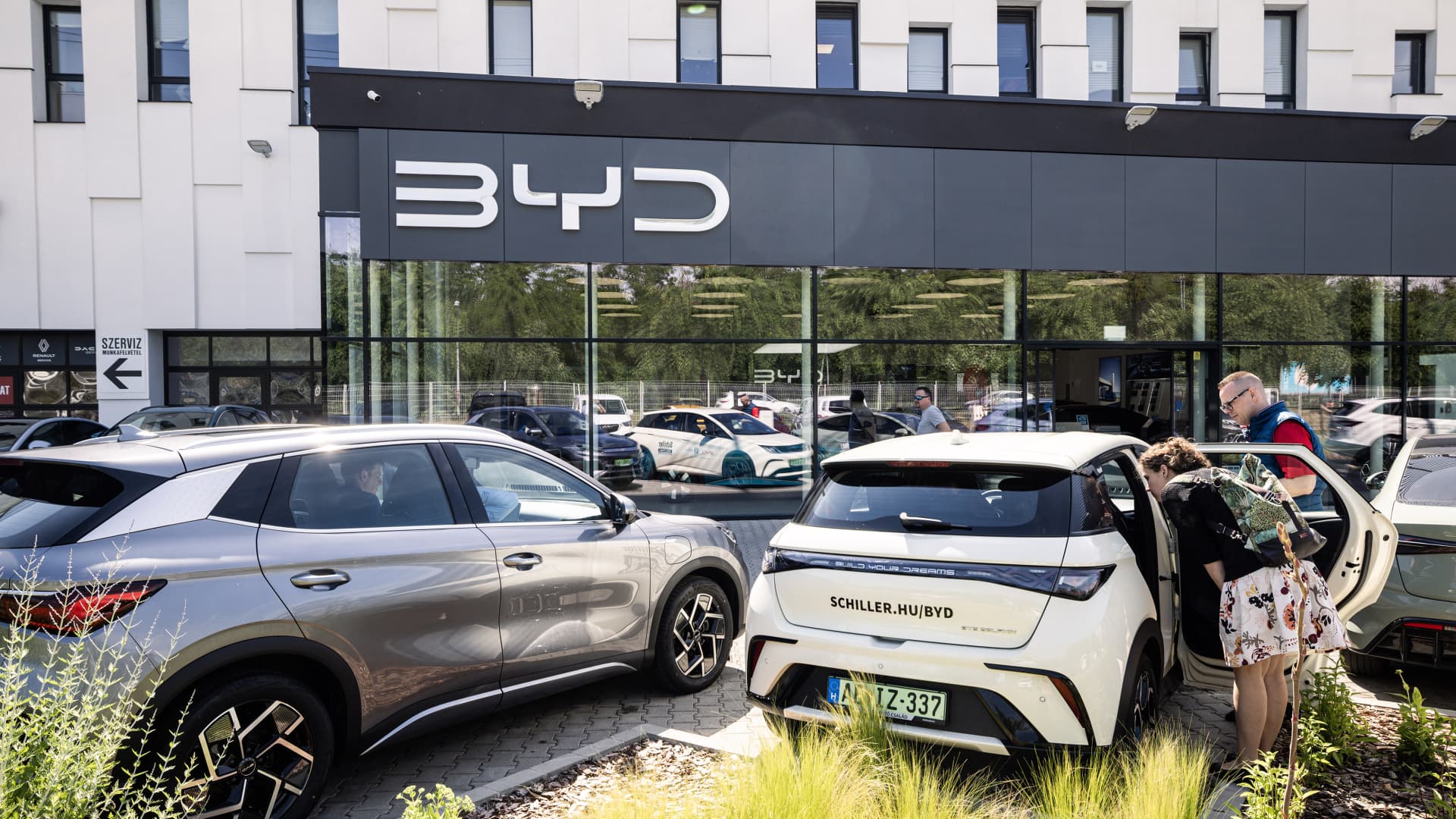
The exterior of a BYD electric vehicle showroom operated by Schiller Auto in Budapest, Hungary on May 27, 2024.
Bloomberg | Bloomberg | getty images
As President Donald Trump meets with Chinese President Xi Jinping this week, lawmakers from both parties are warning the White House not to use the U.S. auto market as a bargaining chip in any deal with Beijing.
The warning stemmed partly from Trump’s January suggestion that he could welcome Chinese automakers if they made vehicles in the U.S. with American workers — comments that were later retracted but still upset auto-state lawmakers, unions and industry groups. In an appearance at the Detroit Economic Club in January, Trump said he would gladly welcome Chinese automakers to manufacture in the US.
“While the Administration is always calling for greater investment in America’s industrial revival, the notion that we would ever compromise our national security is baseless and wrong,” White House spokesperson Kush Desai said in an email.
For lawmakers in auto-heavy battleground states like Michigan and Ohio, even a limited opening to China could be politically explosive. He warned that if heavily subsidized Chinese automakers gain a foothold in the U.S. market, it could threaten domestic manufacturing jobs in the states ahead of the 2026 midterm elections and the next presidential race.
“If your state is in the Rust Belt, allowing Chinese automakers into the U.S. market would be harmful to many people and politically bad,” said Stephen Ezell, vice president of the Information Technology and Innovation Foundation, a Washington think tank focused on industrial competition, which has studied Chinese automakers. “You’re talking about risk to industry, to jobs, to factories and to the entire community.”
So far, Democrats have cast the fight over Chinese autos as vital to protecting union jobs and domestic production, while Republicans are casting it as part of broader economic nationalism to counter Beijing and protect vital industries.
Major Chinese automakers such as BYD, Zhejiang Geely Holding Group and SAIC Motor do not have a retail presence in the US, where they face 100% tariffs and other national security-related barriers.
But exiting the US market is complicated by China’s existing presence in the US auto supply chain.
More than 60 US-based auto suppliers are owned by Chinese companies, according to global consulting firm alixpartners. This includes manufacturers of axles, airbags, windshields and steering systems. According to AlixPartners, Chinese companies account for about 5% of the approximately 10,000 US auto suppliers.
These links extend to some of the most popular vehicles sold in the US, as tracked by the National Highway Traffic Safety Administration.
Toyota’s The latest Prius plug-in hybrid has about 15% Chinese parts. Ford’s The latest Mustang GT uses a six-speed manual transmission sourced from China. General MotorsDespite supporting aggressive trade policies, it has reported that several Chevrolet models, including the electric Blazer and electric Equinox, contain about 20% Chinese parts.
GM has set a 2027 deadline for some suppliers to end their China sourcing relationships over geopolitical issues, Reuters first reported in November.
Ford, Toyota and GM did not respond to requests for comment.
Rep. John Moolenaar, R-Mich., chairman of the House Select Committee on the Chinese Communist Party, speaks at the 2025 CNBC CFO Council Summit in Washington on Dec. 3, 2025.
Aaron Clamage | cnbc
The growing political reaction has already translated into legislative action. Reps. John Moolenaar, R-Mich., and Debbie Dingell, D-Mich., introduced a bill this week that would ban Chinese-made connected vehicles, software and hardware over national security and data concerns. It mirrors Senate legislation from Sens. Elissa Slotkin, D-Mich., and Bernie Moreno, R-Ohio.
Connected vehicles have Internet access and wireless connectivity with other cars or trucks, a technology proponents say could increase road safety.
“Every vehicle on American roads is a rolling data collection device,” Moolenaar said when announcing the bill Tuesday, warning that Chinese vehicles and components could capture information on “location, movement, people and infrastructure in real time.”
The tough stance against Chinese vehicles comes as American consumers grapple with an acute affordability crisis.
average price of a new car The US had $49,461 in April, according to kelly blue book. Consumers in China can choose from more than 200 battery-powered models, including hybrids, starting from as little as $25,000, according to Chinese automotive content and car-shopping platform DCar.
“The reality is that we’re behind Chinese autos in the U.S., but we’re hopeful that automakers can respond through innovation,” Ezell told CNBC. “Ultimately we need to compete through innovation if the industry is to thrive domestically.”
According to Mexico’s National Statistics Agency, Chinese brands have already used their scale and low prices to capture about 20% of the market in Mexico. INEGI and industry groups, and have made deep inroads across Europe, raising fears in Washington and Detroit that the same playbook could work in the US.
But China’s powerhouses argue that cheaper cars can afford long-term costs. He warned that the auto industry could mirror solar panels, where Chinese companies used low prices, state support and scale to dominate global supply chains, driving out higher-cost competitors before gaining greater control of the market.
“There’s a pattern of coming into China, subsidizing costs to keep prices down, destroying an industry and then raising prices,” Dingell said. “This is about the future of America. This is about the future of American workers.”