

America is the world’s leading oil producer. The United States is less dependent on foreign oil than before. And only 8% of the oil we import comes from the Middle East.
So why, then, have gasoline prices at America’s pumps skyrocketed?
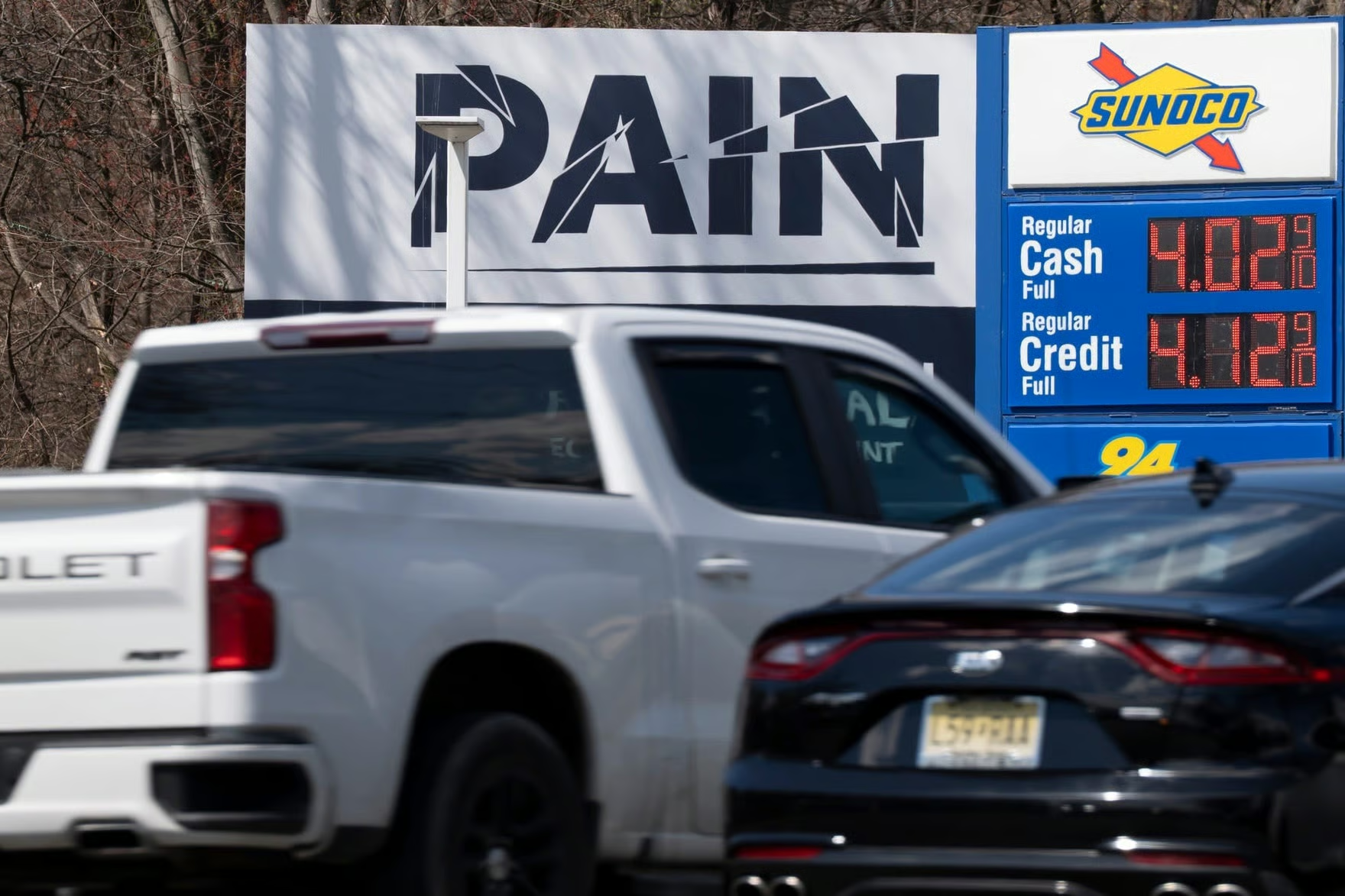
U.S. gas prices rose to an average of $4.18 per gallon on April 28: the highest level not only since the start of the Iran war, but since the early days of the Russia-Ukraine war in 2022. Gas prices are rising at a time when peace talks between Iran and the United States appear to be stalled.
Why did the Iran war raise gas prices here?
In an address to the nation on April 1, President Donald Trump talked about the Iran war and the competition for control of the Strait of Hormuz as if their outcome had little impact on the market for oil and gasoline in the United States.
Trump said, “The United States imports almost no oil through the Strait of Hormuz and will not in the future.” “We don’t need it. We don’t need it and we don’t need it.”
As of January, the US produced more than 13 million barrels of crude oil per day. We export more oil than we import. But we also consume a lot of oil and we import about 6 million barrels a day. Only a small part of it comes from the Persian Gulf.
Based on those facts, you might think that the war in the Middle East would have no effect on gas prices in the United States. You would be wrong.
“This is a global market,” said Mark Zandi, chief economist at Moody’s Analytics. “So, oil literally flows at the highest price. If a tanker can get a higher price in Malaysia than in Rotterdam than in Rio de Janeiro, it will go to Malaysia.”
When the United States launched airstrikes against Iran, oil prices soared worldwide.
Crude oil prices rose from about $67 on Feb. 27 to about $105 on March 30, according to the West Texas Intermediate Index, a benchmark.
Oil prices rose as supplies to the region were disrupted due to the Iran war, the closure of the Strait of Hormuz, sudden threats to oil shipping and collateral damage to oil-industry infrastructure, among other factors.
The war threatened oil supplies in regions that are heavily dependent on oil from the Middle East, including Asia and parts of Europe. Prices went up everywhere including here.
“Everyone is competing for the same barrel of oil,” said James Cox, managing partner of Harris Financial Group. “It doesn’t matter whether it’s produced in Texas or Iran or Saudi Arabia or Russia.”
The United States is the top oil producing country on Earth. But we are also top oil consumers. And America’s oil producers are part of the global market.
“We produce as much as we consume,” Zandi said. “But at the end of the day, the manufacturers here are going to sell to whoever can give them the highest price. They’re businessmen.”
The West Coast is particularly sensitive to oil shocks in the Middle East, as most of its oil comes from that region. That’s why gas prices in California have soared to $5.93 a gallon, said Kate Gordon, CEO of California Forward, a sustainability-advocating nonprofit.
“We don’t get anything east of the Rockies,” he said.
This was not a repeat of the 1970s oil crisis
California and the rest of the nation can be satisfied that the Iran war did not cause gasoline shortages in the United States. Yes, there were long lines for gas, but it was mostly people who wanted to save a few bucks at Costco.
This is a far cry from the oil crisis of the 1970s, which led to rationing, price controls, shortages, national 55 mph speed limits, and long lines at gas stations across the country.
Economists say the Iran war brought more difficulties for American consumers than the crisis. Motorists paid more for the gas they purchased. Petroleum companies earned more from the oil they sold.
Some other countries, more dependent on oil from the Middle East, introduced rationing, four-day workweeks and remote work, and urged citizens to use less air conditioning and more public transportation.
“You could say the U.S. economy, on net, is somewhat insulated from shocks, because we are such a big supplier,” said Nikolai Rusanov, a finance professor at the Wharton School of the University of Pennsylvania. “But that doesn’t help the consumer at the pump.”
When will gas prices fall?
Gas prices have seen a surge in recent days, following news of a fragile ceasefire on April 8. Cox said that even with a ceasefire, oil and gasoline prices will remain high for several months until a new source comes online.
“Insurance on ships passing through the strait will increase,” Zandi said. “There is always a possibility of the ceasefire breaking down and traders will want some premium to cover that risk,” he said.
“That premium will probably persist for quite some time,” Cox said, noting that oil futures, which speculate on prices at a future date, will remain elevated through the end of 2026.
Oil infrastructure in the Middle East has been damaged or disrupted by the Iran war. Some of it “will take years to rebuild,” Gordon said. During that time, the world’s oil supply will be disrupted.
“It’s impossible to get back what we had,” Zandi said. “At least not this year.”
Reporting by Daniel De Vis, USA TODAY/USA TODAY Network via Reuters Connect