

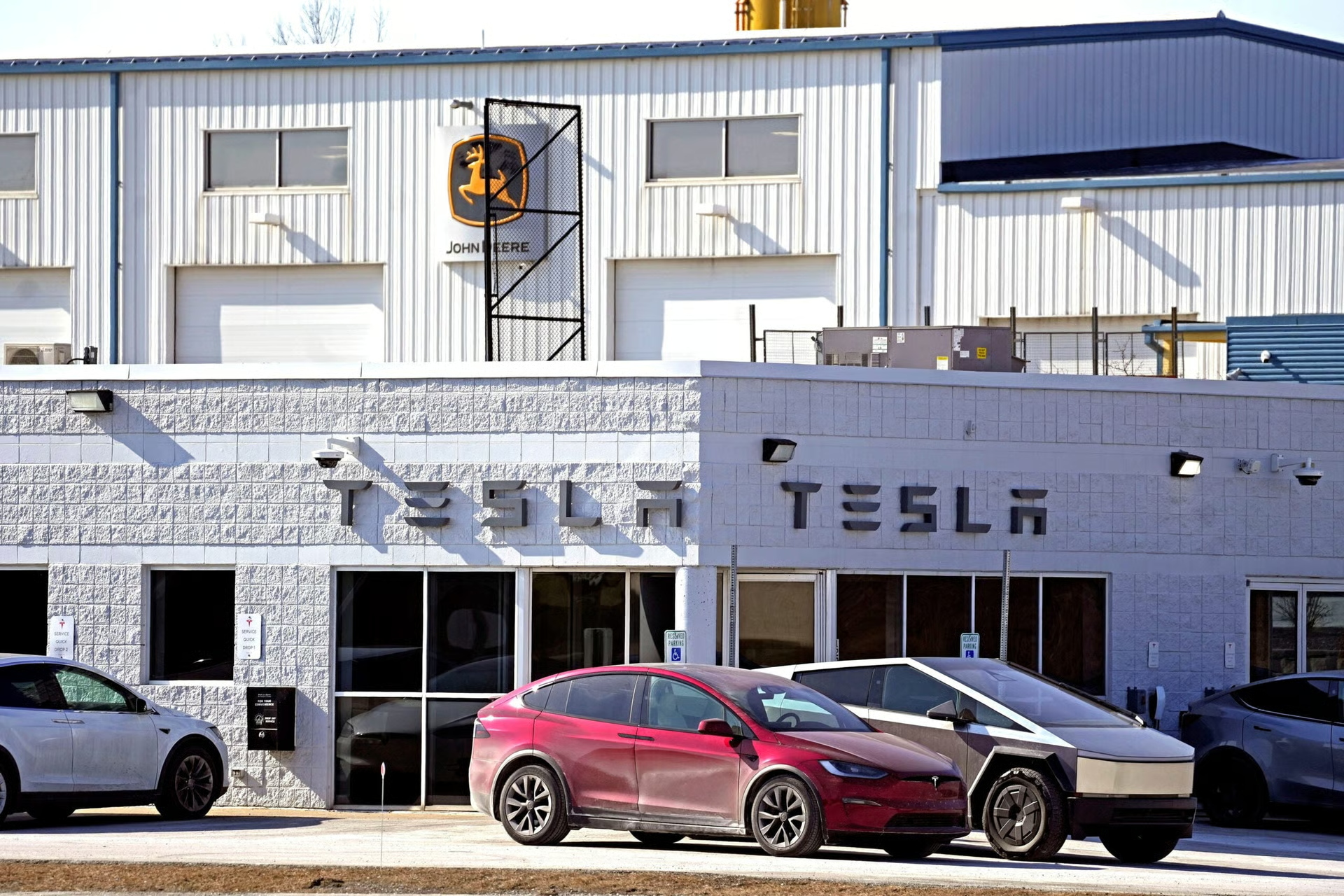
Tesla plans to build robots and semi trucks to the delight of its investors, but auto industry analysts are wondering whether the company is in danger of neglecting its core car business.
This year alone, Tesla has stopped production of its Model S luxury electric sedan and Model X luxury electric SUV, and the company is sitting on thousands of unsold EVs.
The changes come as Tesla’s sales have been sluggish compared with past years and analysts have questioned whether its EV lineup has become too stagnant. According to a report released by the company on April 2, Tesla produced 408,386 cars globally in the first three months of 2026. But the company said it was able to sell only 358,023 vehicles in the first quarter.
“Tesla faces a tough year in 2025, its second consecutive tough year, as its product line ages, and the company is not able to bring high-volume products to market to compensate,” Stephanie Valdez Streety, director of industry insights at Cox Automotive, said in a statement.
The result, Valdez Streety said, is that “Tesla has an aging line of vehicles at a time when the EV market has become far more competitive.”
Why is Tesla turning its attention to autonomy and robotics?
Tesla is facing pressure from its investors to prove it can meet its stated autonomy and robotics goals.
The company’s CEO Elon Musk told investors in Tesla’s earnings call in January that the company is in the process of making a “holistic shift toward an autonomous future.”
“Except for the next-generation Roadster, the only vehicles we will make will be autonomous vehicles,” Musk told investors on Jan. 28.
Musk predicted on Tesla’s April earnings call that its Optimus robot would soon be his company’s most important product.
“As you’ve heard me say many times, I think Optimus will be our biggest product, not just Tesla’s biggest product, but probably our biggest product ever,” Musk said on the call. “And I’m confident in that conclusion.”
Tesla also announced that its first autonomous Semi truck has rolled out of its production facility.
What do Tesla investors say?
Tesla investors have made clear that they are betting on the company being successful in its transition to autonomy and robotics.
Bank of America said in a note to investors on March 4 that it was advising investors to consider buying the Silicon Valley automaker’s stock as it is “leading the Auto 2.0 landscape and the next era of mobility.”
“We expect TSLA to rapidly become a leader in robotaxi services given its ability to achieve greater profitability than competitors,” Bank of America analyst Alexander Perry said in the note.
Jake Behan, head of capital markets at financial services firm Direxion, said in an email that Tesla’s performance in its early efforts is as important to investors as its early cutting-edge electric cars were a decade ago.
“Tesla is no longer the primary proxy for Elon Musk that it used to be,” Behan wrote. “As the focus turns to their broader ventures into AI and autonomy, the stock has to stand more on its own merits, and that raises the bar for execution.”
How many unsold EVs does Tesla have?
Tesla produced 50,363 more electric cars than it could sell in the first three months of 2026, at a time when overall demand for EVs is declining.
EV sales declined in 2025, as President Donald Trump and Congress eliminated the popular $7,500 tax credit for EV buyers that had been offered to buyers for most of a decade.
According to the Alliance for Automotive Innovation, EV sales are projected to account for 9.6% of U.S. auto sales in 2025, down from 10.2% in 2024.
Another problem for Tesla’s new cars is the abundance of used Tesla cars that are now on the market as pre-owned EVs are increasing consumer interest.
“Looking at cross-shopping data, it looks like 41% of new Tesla buyers considered a used Tesla,” said Sean Tucker, managing editor of Kelley Blue Book. “The 2026 Tesla’s biggest long-range competitor is the 2023 Tesla.”
But despite all the headwinds, Tesla is still the country’s largest EV seller. The company’s number of unsold EVs in the first three months of 2026 was more than the total number of vehicles sold by other pure EV makers like Rivian and Lucid in 2025.
Cox analyst Valdez Streety said Tesla’s scale gives it an advantage on pricing that other EV makers can’t use.
“Selling about 600,000 vehicles per year in the U.S. gives Tesla the ability to be vertically integrated — building its own batteries, motors, software and electronics — which removes supplier margins on the most expensive parts of the vehicle,” he said. “Competitors are fighting higher manufacturing costs and a retail cost structure that Tesla doesn’t have.”