

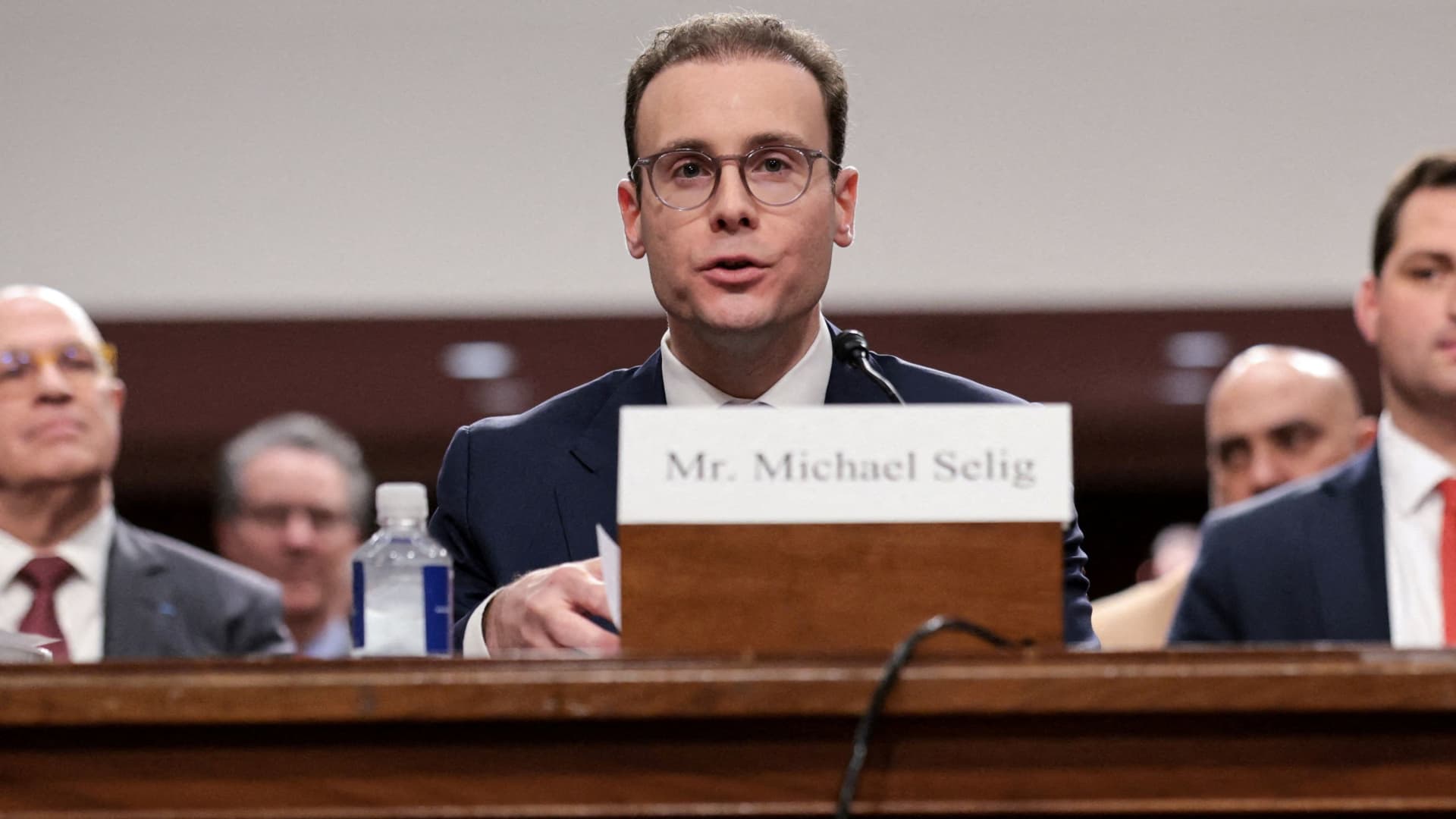
Michael Selig, nominated by President Donald Trump to serve as chairman of the Commodity Futures Trading Commission, testifies at the Senate Agriculture Committee hearing on his nomination on Capitol Hill on November 19, 2025.
Jonathan Ernst | reuters
A group of Democratic lawmakers is urging the Commodity Futures Trading Commission to issue a rule that would aim to rein in prediction markets, curb insider trading and ban certain types of event contracts.
In a letter first shared with CNBC and sent to the CFTC on Thursday, a group of congressional Democrats led by Jeff Merkley of Oregon called on the federal agency to address the “rapid erosion of integrity” within prediction markets like Kalashi and PolyMarkets.
“We strongly encourage you to use your authority to preserve the intent of prediction markets and the congressional intent behind the Commodity Exchange Act by issuing a rule that prohibits insider trading and corruption in the markets and prohibits event contracts on the outcome of elections, wars and military actions in the US or abroad, sports and government actions without a legitimate economic hedging interest,” the lawmakers wrote.
Sens. Richard Blumenthal of Connecticut, Chris Van Hollen of Maryland, Sheldon Whitehouse of Rhode Island and Representative Jamie Raskin of Maryland also signed the letter.
The popularity of prediction markets has grown over the past year, which has attracted the attention of lawmakers, especially after many bets were placed on the Polymarket platform ahead of major world events.
Last week, a US soldier was arrested in Venezuela for allegedly placing bets on Polymarket ahead of military action, netting him $400,000. Kalshi, another forecasting market giant, has suspended and fined three candidates for elected office for allegedly trading on their own campaigns.
A series of bills introduced since the beginning of the year aim to curb insider trading and, in some cases, ban event contracts on sports, elections, military and government actions. Merkley led a bill in March that would bar some government officials from using prediction markets altogether. Another bill, introduced by Merkley in the Senate and Raskin in the House, would ban prediction market bets on elections, wars and sports.
In the letter, the group says event contracts tied to election results “pose a threat to our democracy and elections.”
“These types of contracts did not exist in the United States before 2024, and for good reason,” he wrote. “Election-related prediction contracts create financial incentives for political insiders involved in polling to subvert the will of American voters by altering their behavior.”
The game is the most popular type of event contract by volume, accounting for approximately 90% of bets placed on Kalushi in the year ending in February. Congressional Research Service. While sports is also the largest single category on Polymarket, the report found that this category accounted for 38% of event contracts on that platform. The companies have also drawn the ire of state regulators and casinos, who argue that sporting event contracts are merely gambling.
“Contracts on the outcome of a game or event are a far cry from the intent of the CFTC’s mission. They are one of the most egregious examples of how these contracts represent gambling and violate states’ rights to regulate this activity,” the lawmakers wrote.
The CFTC issued a call for public comment in March as part of its rule-making process.
“Today’s action is an important step in the Commission’s continued effort to promote responsible innovation in our derivatives markets,” the CFTC Chairman said. Michael Selig said in a statement The announcement of the rulemaking period, which closed on Thursday. “It begins the process of creating new rules based on a rational and consistent interpretation of the Commodity Exchange Act, while assuring the American people that the CFTC will exercise its exclusive jurisdiction over prediction markets.”
The CFTC’s rulemaking comes as the agency has fought against states that have tried to regulate prediction markets, arguing that authority belongs to the federal government.
The CFTC has filed suit against several states that issued cease-and-desist orders for prediction markets, saying they violated gambling laws. In April a federal appeals court ruled that New Jersey regulators could not prohibit the use of calamitous wagers on sporting events.
“What we’re seeing is an effort by state gaming commissions to effectively nullify federal law,” Selig said on CNBC’s “Squawk Box” in March, before the New Jersey decision was released.
Disclosure: CNBC and Kalshi have a commercial relationship that includes a CNBC minority investment.