

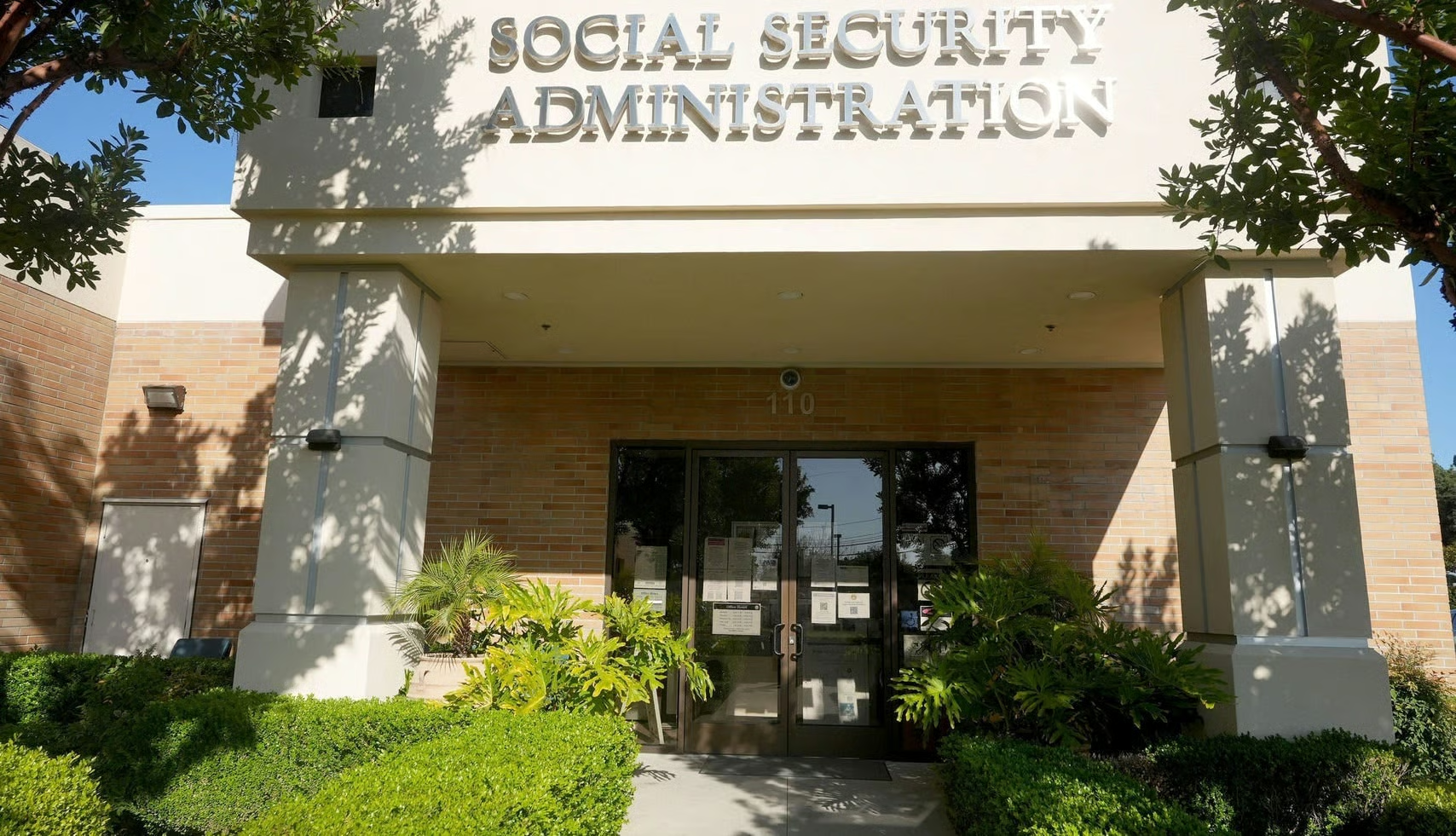
A Washington think tank recently caused a stir with a paper proposing limiting annual Social Security benefits to $100,000 in order to bolster the retirement trust fund.
Social Security will face a shortfall by 2032. If Congress does nothing, the research shows, retirees would see a 28% cut in monthly benefits.
But the “six figure limit” proposal introduced in March by the non-partisan Committee for a Responsible Federal Budget received sharp criticism. Retirement advocates view any limits or cuts in Social Security benefits as a slippery slope.
Fortunately, there is no shortage of other ideas for fixing Social Security.
“You and I can do it in an hour,” said Alicia Munnell, senior advisor at the Center for Retirement Research at Boston College, speaking to USA TODAY in April. “It’s not hard. It’s just a question of willpower, which is completely missing.”
Congress will embark on a dangerous path to reform Social Security, a program so valuable to many that it is often called the third rail in American politics.
Here are the eight most popular proposals to close Social Security’s funding gap and the advantages and disadvantages of each.
Increase income tax threshold for Social Security
Social Security revenue comes from taxes on income. But there is a limit: In 2026, only income up to $184,500 will be taxed to fund benefits.
Raising the income threshold would result in more taxes to fund Social Security.
One proposal would raise the income threshold to a level that would cover 90% of all wages. The current limit covers slightly more than 80% of all income. Setting it at 90% would put the limit around $330,500, according to the non-partisan Committee for a Responsible Federal Budget.
The CRFB estimates that this reform, by itself, would reduce the Social Security funding gap by 26%.
remove income limit
A more drastic option: Remove income limits so that all workers’ income is taxed for Social Security.
The CRFB estimates that eliminating the income limit would fill 68% of the Social Security gap.
Argument against: Eliminating the cap would burden higher earners. Already, top earners receive a much smaller share of their past income in Social Security benefits than lower-income Americans.
Increase payroll tax rate
The money Americans pay into Social Security comes from payroll taxes. The total tax is 12.4% of your income, half paid by you, half by your employer.
The CRFB estimates that increasing that tax rate by one point, to 13.4%, would reduce about one-quarter of the Social Security funding gap. A two-point increase would take half of that off.
The big downside: It’s a tax increase.
Increase payroll taxes to health benefits
Under current law, payroll taxes apply only to income, not other forms of compensation such as health insurance.
The CRFB estimates that expanding the payroll tax to cover employer health insurance contributions would cover 23% of the Social Security shortfall.
Increase Social Security Retirement Age
Until the 1980s, age 65 was considered the “full” retirement age for receiving Social Security. In 1983, with Social Security facing bankruptcy, Congress passed legislation that gradually raised the full retirement age to 67.
This is the age when you qualify for full Social Security benefits. You can claim earlier, but your check is smaller. You can also claim later and get a bigger payout.
With a new shortage looming, a possible correction would raise the retirement age again. The CRFB estimates that the one-year increase would close 12% of the Social Security funding gap.
Life expectancy by index retirement age
One downside of raising the retirement age is that whatever age you choose – 65, 67 or 68 – may seem arbitrary.
A more fact-based alternative might be to index Social Security’s retirement age with hard data on human life expectancy.
In this proposal, the “full” retirement age would move up or down with changes in life expectancy, which has generally been rising over time.
The CRFB estimates that the policy change would reduce 18% of the Social Security funding gap.
One drawback: Critics say raising the retirement age would disproportionately harm low-income Americans. Research shows a connection between income and longevity: Older Americans living in poverty die several years earlier than those earning more.
Slower profit growth for higher earners
Social Security benefits are progressive: The lower your income, the more share you get back in your Social Security check.
Under current law, Social Security “replaces” 90% of your income up to $1,286 per month. The replacement rate drops to 32% for incomes between $1,286 and $7,749, and to 15% for incomes above $7,749.
Changing the percentage can save money. One proposal would add a fourth bracket, in which replacement rates would drop from 90% to 30%, 10% and 5% as income increases.
The math is complicated, but CRFB estimates the change would reduce 41% of the Social Security funding gap.
cap social security benefits
The final proposal calls for setting a limit on the total Social Security benefits that retirees can receive in a year. Recently, the CRFB suggested limiting benefits to $100,000 for couples and $50,000 for single retirees.
The CRFB estimates that that limit, indexed to inflation for future years, would close at least one-fifth of Social Security’s funding gap.
However, critics warn that benefit caps could erode middle-class gains.