

Be prepared to pay more for your water. Too much.
A new study published July 8 shows that in some parts of the US, mainly in the West, hotter, drier weather caused by global warming could lead to dramatic increases in residential water bills over the next few decades, with some people seeing their monthly charges double.
In the study, which appeared in the peer-reviewed British journal Nature Sustainability, researchers at Stanford University found that costly drought-resilience projects, such as desalination and water reuse systems, could push many low-income households into a severe water affordability crisis.
“Climate change puts pressure on water supplies, and forces utilities to build expensive new infrastructure to maintain reliability,” study lead author Jennifer Schecker of Stanford University said in a statement.
And according to study co-author Sarah Fletcher of Stanford, “Climate adaptation and water affordability are on a collision course.”
What is the main point of the study?
Scherker told USA TODAY that in some water-stressed cities, climate change is likely to double water bills, as it would require cities to make costly new infrastructure investments. “This is a problem because many people are already struggling to pay their water bills and it will get worse with climate change,” he said in an email to USA TODAY.
Currently, water infrastructure in the United States is funded primarily by utilities through increased water rates, he said. “It pits water affordability against reliability, when in reality, we need both.”
Why would water become more expensive if the weather is hotter and drier?
If the weather gets hotter and drier, demand for water in cities is likely to increase while water supply will decrease, Scherker said. This may require utilities to invest in more alternative supply infrastructure, such as potable reuse, desalination, or even water transfer infrastructure. “This infrastructure is expensive,” he said.
“Currently, the main way utilities pay for this infrastructure in the U.S. is through increased water rates, which increases water bills for households,” Scherker said.
Water prices have outpaced inflation
According to the study, the average cost of tap water in the US has increased three times faster than inflation over the past two decades, largely due to aging infrastructure and delayed maintenance. Moreover, according to Schecker and his study co-authors, climate change is putting a new and poorly understood pressure on those existing strains.
In one example, the study found that the average water bill for the poorest residents of a city (Santa Cruz, California) could increase from about $60 to $111 per month (in today’s dollars) in a dry climate scenario.
Incredibly, the study says that more than 5% of households would have to devote a third of their income to water, which would likely lead to painful trade-offs with food, health care and other necessities.
Researchers look at Santa Cruz
To understand how projected changes in temperature and precipitation over the next two decades could affect local water supplies and costs, the research team analyzed data from Santa Cruz, California. The small coastal town is almost entirely dependent on local surface water and a reservoir.
Is this issue specific to the western US, or could it be a national problem?
“We focused on California and western U.S. cities to identify other locations with Santa Cruz-like characteristics, primarily because we think this problem is more likely to be prevalent in areas with water scarcity,” Scherker said.
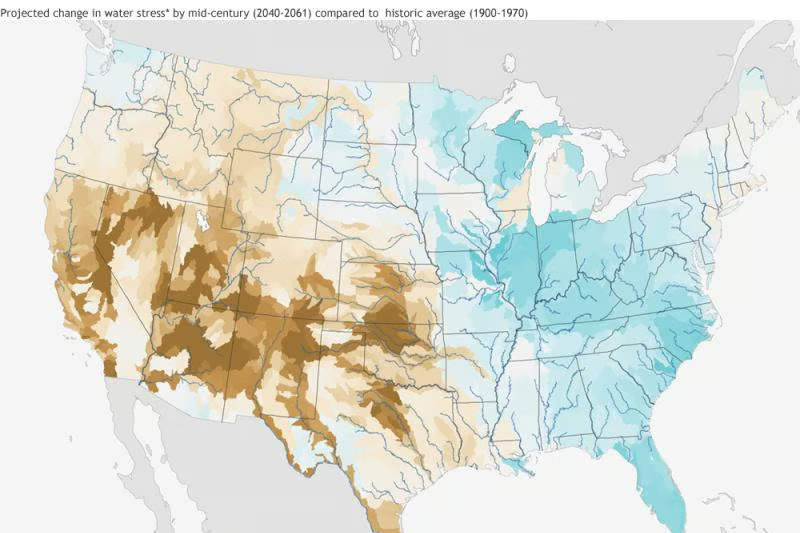
Indeed, according to the US Geological Survey, the West and Southwest will likely remain ground zero for water issues in the US, as longer and more intense droughts are predicted in parts of the region, reducing water availability for cities, agriculture and ecosystems. Additionally, federal climate assessments show that many watersheds in the West could see reductions in surface water supplies.
What is the solution to the problem?
“I think there are several solutions,” Scherker told USA TODAY via e-mail. “One is more assistance, such as grants and infrastructure funding programs from states and the federal government. The other is a permanent low-income household water assistance program. The federal government started it in 2021 during the COVID-19 pandemic, but the program has since expired.”
Fletcher, co-author of the study, said in a statement that “ensuring reliable water access for everyone will require intervention at the state and federal level that will go far beyond what individual utilities can do on their own.”
Doyle Rice is a national correspondent for USA TODAY with a focus on weather and climate.