

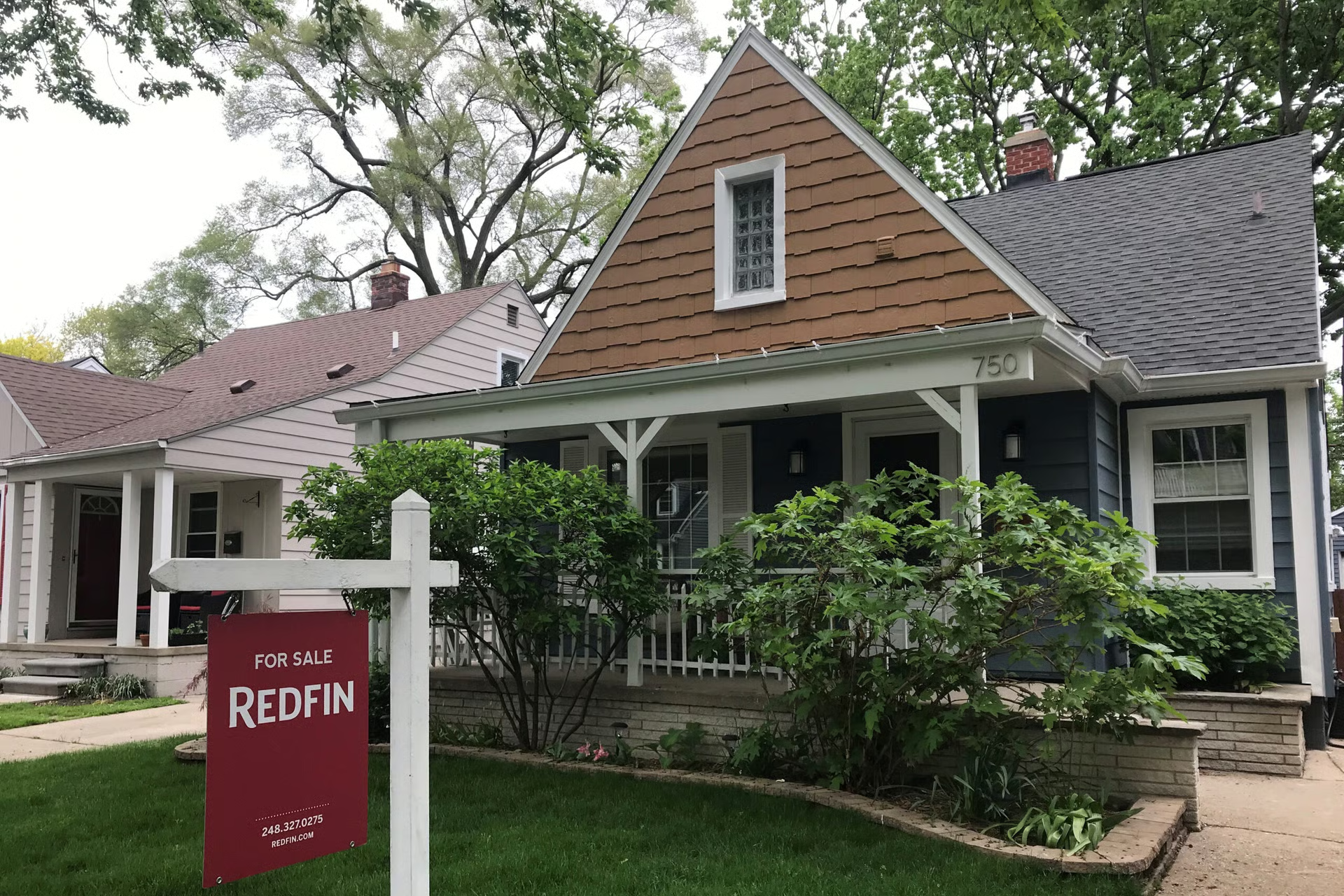
Any potential home buyer struggling to find an affordable home would never have imagined that some lucky ones might actually be thinking twice about selling their home because they would make so much more money.
seriously?
There is a discussion in the real estate world about an old tax limitation related to potential taxable profits that some people face when selling a home they have lived in for years. Some people call this the “hidden home equity tax.”
This should not have happened.
When did we see the first capital gains on home sales?
Nearly 30 years ago, then-President Bill Clinton called for allowing married couples to keep up to $500,000 of profit — tax-free — from the sale of their principal residence. Both Democrats and Republicans liked the idea and it was included in sweeping changes when Congress passed the Taxpayer Relief Act of 1997.
The initial limit seemed so high at the time that it was seen as essentially eliminating capital gains tax on the sale of your primary home.
Except that that limit cap was never indexed to go up based on inflation or rising home values. As a result, depending on where you live, more people than some will not be eligible for the home sale exemption. And if home values continue to rise the numbers are expected to continue to rise.
Currently, a person selling a home is allowed to keep up to $250,000 in capital gains on the sale of a home they own and used as a principal residence for at least two of the past five years up to the date of sale.
Married couples who file jointly do not face taxes on capital gains up to $500,000 on the sale of the same home.
“That number hasn’t really held up over time,” said Joel Berner, senior economist at Realtor.com.
Berner said the risk of paying any capital gains tax on a home sale is not well known to many people because the 1997 exclusion was so large for decades that the tax was not applied to many sales of a primary home. No one even talked about this issue for years.
Your chances of being hit by capital gains taxes will vary greatly depending on the appreciation of homes in your community, how long you’ve lived in the home, what state you live in, and whether you’re married or single.
Capital gains hot spots may increase
New research from the National Association of Realtors estimates that approximately 13.1 million homeowners nationwide – 15% of all owner-occupied homes – already have unrealized capital gains on their homes that exceed the limit allowed for capital gains tax exemptions.
In Michigan, it is estimated that 5.5% of homes exceed the current limit. In Minnesota it is 7.7%. In New Jersey, it is currently 22.6%. According to this study, in California it is 43.6%.
If home values rise as expected, many more homeowners could face this tax burden, and the study has some good predictions for how many people may ultimately be at risk if we see some strong home growth in future years.
According to the study, a 30% increase in home prices nationwide would effectively double the number of homeowners exposed to foreclosure by more than 27 million homes – or 31.3% of homes nationwide.
The study notes that since 1997, U.S. home prices have increased nearly three and a half times nationally, and even faster in many metropolitan areas. Many communities saw some serious price increases in 2021 and 2022 after a huge surge in demand following the onset of the COVID-19 pandemic.
Risk remains fairly low in many Midwestern markets.
What kind of tax change do some people want?
Still, many real estate professionals would like to see major changes to the limits, perhaps doubling the limits to $500,000 for singles and $1 million for married couples or eliminating the capital gains tax on the sale of a primary home altogether. He says it’s a way to free up some housing supply, boost home sales in some markets and possibly prevent more problems in the future.
“It just opens up the housing market,” Berner said. “It allows for more transactions and more flexibility for people moving forward.”
The theory is that housing supply is also influenced by the willingness of existing homeowners to sell their homes and move.
Berner said raising the limit would give more people, including older people, more flexibility to sell their homes without worrying about a big income tax bill.
“The people who have been penalized the most are people who have been home for a long time,” Berner said.
They may have bought during major downturns, such as in early 2011 after the financial crisis occurred. They may be older adults who have lived in the home for 30 years or more.
Some argue that only ‘small groups of high-income’ taxpayers will benefit.
Make no mistake, most people do not have to pay any capital gains taxes on the sale of their home, especially if they are married, living in an area with modest home values and they are not looking at a gain of more than $500,000 on the sale of their home.
According to Elena Patel, co-director and senior fellow at the Urban-Brookings Tax Policy Center, raising the tax-free level of capital gains on a primary residence will not meaningfully increase housing supply.
According to research from the Urban-Brookings Tax Policy Center, such a tax change, as is now being proposed by some in Congress, “would provide large benefits to a small group of high-income, high-wealth households.”
Under current law, most families already pay no capital gains tax when selling a primary residence, Patel said.
Under current law, the report said, 95% of all households — and 90% of families age 65 and older — would pay no federal capital gains tax on a home sale because their realized capital gains fall below the current exclusion threshold.
“Expanding the exclusion will primarily provide additional tax benefits to a relatively small group of high-income, high-wealth households, while having a limited impact on overall housing availability,” Patel said.
“It will also enhance tax preferences for households that already receive substantial housing-related tax benefits, including the mortgage interest deduction.”
Who might be vulnerable?
The study notes that many older homeowners who have become widowed or aged after divorce may be hit by unexpected capital gains taxes on the sale of a home they have owned for several years.
“About 58% of uninsured homeowners are single filers,” the report said.
Others who may be vulnerable include homeowners who purchased their home before the major price increases in the period between the early 2000s and after 2012.
The report said California stands out due to both its large homeowner base and decades of strong price appreciation. But other large states like Texas, Florida and New York also see large numbers of homeowners with profits above $250,000 due to the scale of their housing markets, the report said.
It is difficult to judge what might prevent an older homeowner from selling his property and paying taxes. But some people may be wary of paying more taxes.
Longtime homeowners are “struggling with maintenance costs, rising insurance and all these things that make it difficult for them to buy a bigger house. But if they sell the bigger house, they get hit with this capital gains tax. So, they’re deciding to stay put,” Berner said.
How capital gains tax on home sales works
How much you’ll actually pay in taxes may vary significantly.
Let’s say you’re single and you bought that house in 1996 for $120,000 and now want to sell it for $420,000. In that example, a single individual would be looking at some level of taxable profit. But the amount of taxes you pay may be less than you think.
“One of the biggest misconceptions is that homeowners think the entire gain becomes taxable if it exceeds the exclusion amount. That’s not true,” said Tom O’Saben, director of tax content and government relations at the National Association of Tax Professionals.
A single filer can generally exclude up to $250,000 of gains, and married couples filing jointly can exclude up to $500,000 of gains if other rules are met.
“Only profits above those limits are potentially taxable, assuming they meet other rules,” he said.
You might be looking at a $50,000 taxable gain in this example, you might not.
Sure, you want to do your homework to minimize your tax bill. “Expenses made for home improvements can increase your basis in the home and, therefore, reduce your gain,” said Mark Luscombe, principal analyst at Wolters Kluwer Tax & Accounting in Riverwoods, Illinois.
We’re talking about reducing your taxable profit by taking into account larger expenses you made to improve the home, such as kitchen remodels, new additions or adding a new HVAC system. No costs for routine maintenance, such as painting your bedroom.
“Closing costs on sales allocated to the seller can also reduce profits,” Luscombe said. “However, any depreciation claimed over the years from business or rental use of the property can reduce the basis and increase profits.”
Taxpayers should take the time to ensure that they calculate their cost basis correctly.
Long-term capital gains on assets held for more than one year are typically taxed at preferential federal rates of 0%, 15% or 20%, depending on income, O’Saben said.
For many middle-income taxpayers, an additional $50,000 of taxable long-term gains could generate about $7,500 in federal tax at the 15% capital gains rate.
State tax rates vary. Some states have no income tax, while other states tax capital gains as ordinary income. In a state with a 5% income tax, O’Sbane said, a $50,000 gain could add about $2,500 to state taxes.
And you want to make sure you’re eligible for the exclusion.
According to the Internal Revenue Service, “Generally, if you excluded gain from the sale of another home during the two-year period before the sale of your home, you are not eligible for the exclusion.”
Luscombe said some unique circumstances may arise that may also disqualify you from exclusion.
“Some people forget that you have to wait two years before you can re-claim the exclusion,” Luscombe said.
“This may come up, for example, when a couple gets married and one spouse sells their home and moves in with the other, and then they quickly start looking for a larger home and sell the other spouse’s home within a two-year period.”
Or in some cases, he said, people may forget that any gain associated with depreciation claimed on a home, business or rental activity after May 6, 1997, is not eligible for the capital gains exclusion and may be taxed at the 25% capital gains rate.
We’re talking about some pretty complex rules. And yes, there are some exceptions – a partial exclusion may be available if the full two-out-of-five-year rule is not met in certain circumstances, Luscombe said. Consider changes in employment, health reasons or other unexpected circumstances, such as divorce, legal separation, multiple births from the same pregnancy, or natural destruction or condemnation of the residence.
Obviously, even lawyers acknowledge that raising the capital gains exclusion limit will not fix all the problems associated with the limited supply of homes. Much more needs to be done.
“The biggest part is building more homes. Anything that encourages builders to deliver inventory is really the ultimate solution,” Berner said.
In general, he said, there would have to be about 4 million more homes in the United States — or about a 5% increase — to equal the number of homes.