

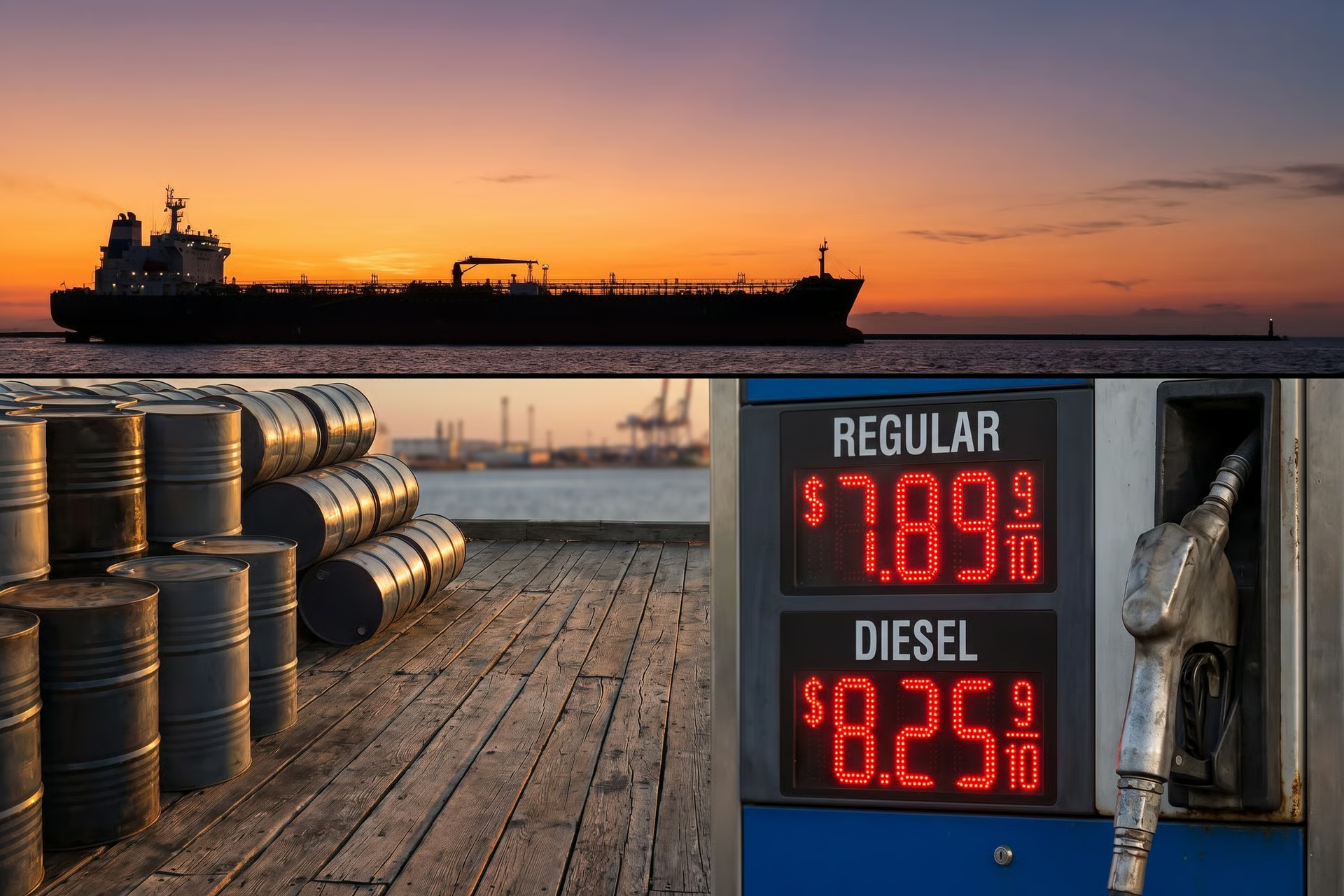
The United States exported oil at a record level in April to fill a global supply gap amid the Iran war, even as gas and oil prices remained stubbornly high.
April exports averaged 5.3 million barrels a day over the four weeks, up from 3.8 million at the end of March, according to weekly export data from the U.S. Energy Information Administration.
The week ending April 24 was exceptional as exports rose to 6.4 million barrels per day and rose back to 4.8 million barrels per day in the following week. Despite a decline of more than 2 million barrels per day, crude oil exports are still well above the nearly 4 million barrels per day shipped abroad in the same period last year.
“This is a really big one-week jump,” said Brian Prest, an economist at Resources for the Future. “The week ending April 24 is the first week in US history where the US has been a net exporter.”
Bridging the global supply gap
The rise in US exports reflects how oil markets are adapting to the supply disruption caused by Iran closing the Strait of Hormuz following US and Israeli attacks on the country since February 28.
Market participants are looking for ways to link supply to demand amid historic supply disruptions, said Clayton Siegel, senior fellow for energy security at the Center for Strategic and International Studies. “Oil markets are functioning efficiently even during times of crisis.”
Siegel said the world has lost 13 million barrels per day from the Middle East over more than two months because of the war. Regions that rely heavily on Middle Eastern oil, particularly Asia, are facing supply shortages.
Thus, the United States, the world’s largest oil producer, has the opportunity to “temporarily fill the gap in worldwide oil supply.”
Why not keep the oil here?
Right now, it’s better for U.S. producers to export oil because foreign buyers are paying more for it than domestic buyers, said Greg Upton, executive director of the Center for Energy Studies and a professor at Louisiana State University.
Since the beginning of the war, the United States has exported more than 280 million barrels in nine weeks, depleting the country’s strategic petroleum reserves in the process. The Energy Department released about 23 million barrels from the reserve since the end of March, part of the 172 million barrels the DOE is authorized to release by President Donald Trump. As of May 1, reserves stood at about 392 million barrels.
Still, oil and gas prices remain high.
Brent crude oil, the international benchmark, was trading above $100 a barrel as of 4 p.m. EDT on May 6. West Texas Intermediate crude, which comes from US producers, fetched about $95.
However, this may change at some point. If WTI becomes more heavily leveraged, and demand for Brent decreases, the difference between the two prices may narrow, making WTI less attractive. More importantly, the cost of moving Brent from the Gulf Coast to places like Asia and Europe could also begin to rise, said Rob Wilson, president of East Daily Analytics, an energy consultancy.
Experts say keeping more oil in the United States will not lower domestic gasoline prices.
Siegel said, the price of oil used everywhere in the world is determined at the global level. “A supply disruption anywhere leads to higher prices everywhere.”
According to the latest AAA data, the current national average gas price per gallon is $4.54.
Even as crude oil remains in the United States, domestic refineries are already running near maximum capacity. “No matter how much more crude you have here instead of sending overseas, we’re not going to be able to make more gasoline here,” Siegel said.
What’s next for gas prices?
Experts say whether the price of US gas will continue to rise or begin to fall will depend on how long the disruption in the Middle East lasts.
“Unfortunately, we’re probably on track to again see the all-time high of pump prices nationwide, just above $5 a gallon, that we saw in 2022,” Siegel said.
In the summer of 2022, the national average gas price in the United States rose above $5 per gallon, due to Russia’s invasion of Ukraine.
“This is simply not sustainable,” Siegel said as the United States continues to supply oil to the rest of the world to fill the energy gap created by the war. “If we want fair fuel prices we have to get those Middle East export flows going again.”
But American companies can also increase supply.
On May 5, President Donald Trump lauded “great progress” toward a deal with Iran. Global oil markets reacted, causing prices to fall sharply. Still, the conflict has not yet made progress and the longer it drags on, the more incentive American producers will have to increase their production, Wilson told USA TODAY.
Shale producer Diamondback Energy said on May 4 it would step up both its fracking and drilling operations, and cited higher prices as a “catalyst”. Wilson thinks other manufacturers may follow suit.
At the end of the day, American consumers will have to pay the price of what’s going on in the global market. With resources for the future, Perst said, “Whether it’s good or bad depends on those global events.”
On the other hand, if the conflict drags on long enough, U.S. lawmakers may be motivated to set policy to protect American consumers, Upton said. As recently as 2016, US producers were not allowed to export oil. He said the ban was lifted only because domestic refineries could not remain operational.
Reporting by Dian Zhang and Andrea Richier, USA TODAY/USA TODAY Network via Reuters Connect