

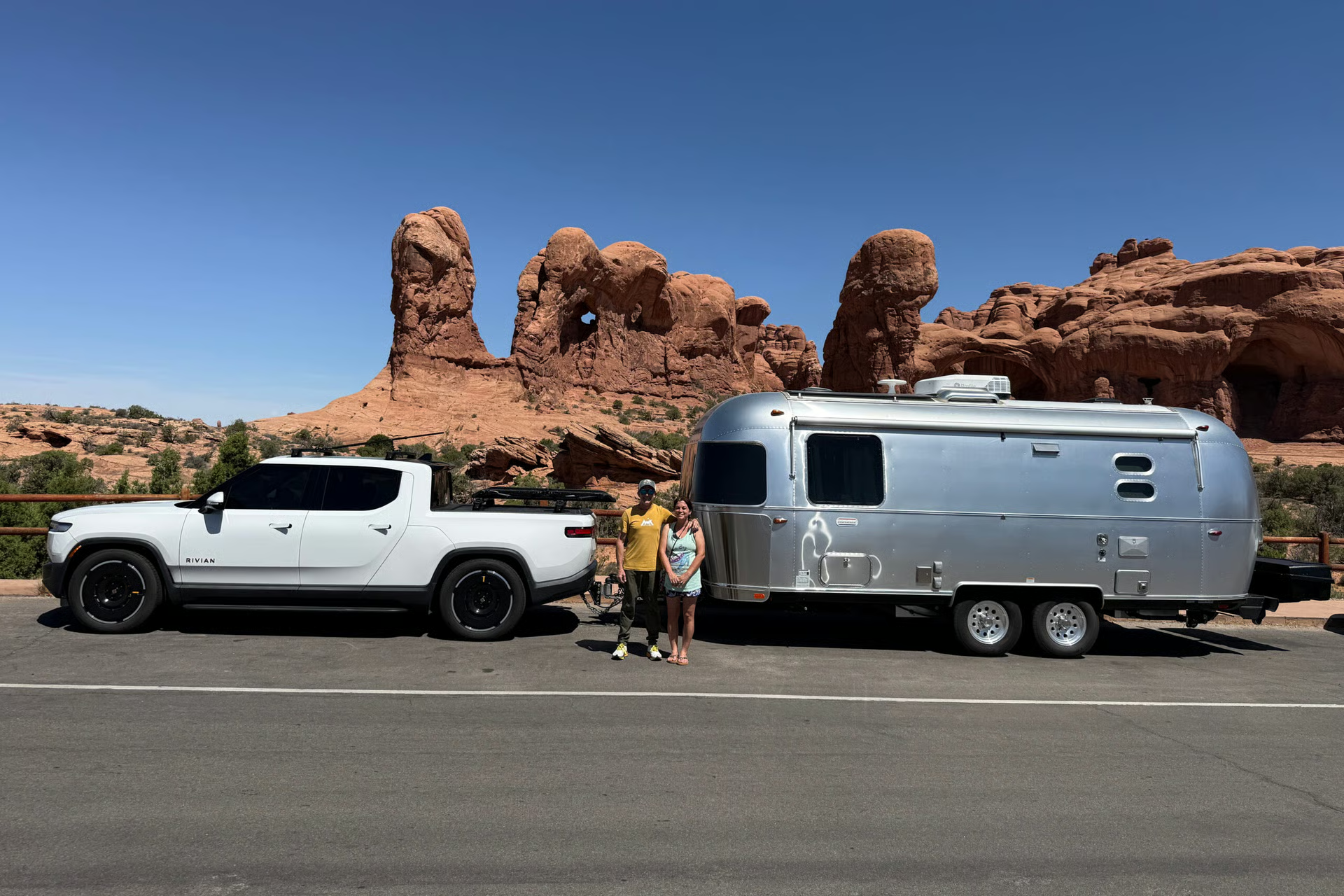
Eric Perkins is towing his shiny silver Airstream camper on a nearly 6,000-mile road trip around the United States that won’t burn a drop of gas or diesel.
Their secret: a battery-powered Rivian R1 pickup, which allows them to tow their 23-foot camper without worrying about the cost of fuel. He’s moved from San Diego to Branson, Missouri, and is now moving home to California from Moab, Utah.
With the national average price of regular gas hovering around $4.16 a gallon and diesel around $5.31, Perkins, 49, is a little happier about his EV — even though many of his fellow campers consider driving a battery-powered pickup a political choice. Perkins’ recharging tab for the trip so far is less than $750, which is dramatically cheaper than driving a traditional pickup.
President Donald Trump has moved to eliminate incentives to buy EVs, encouraging manufacturers to make gas and diesel vehicles instead. But according to industry experts, Trump may inadvertently push more Americans into EVs because of the war he started with Iran and the resulting rise in gas prices.
“I get a lot of negativity from people who think somehow burning diesel is more American,” said Perkins, a legal consultant and self-described libertarian. “And I think Trump is going to be the most pro-EV president in history.”
Trump and Teslas
After taking office in his second term, Trump and his team began rolling back federal regulations and eliminating tax incentives that spurred thousands of drivers to buy EVs from startups like Tesla and Rivian, but also more traditional manufacturers like Nissan, Toyota and GMC. Trump said he believes Americans, not government regulators, should choose what types of vehicles people drive.
In addition to eliminating subsidies, the White House softened Biden- and Obama-era rules designed to push traditional automakers to offer more EVs by tightening tailpipe emissions standards. According to the Environmental Protection Agency, while EVs require electricity to run, they produce fewer carbon emissions overall.
Surveys show that EV ownership is generally broken down along partisan lines, but conservatives became more willing to consider purchasing an EV after Tesla CEO Elon Musk aligned himself with Trump and supported his presidential campaign.
After reassuming the presidency, Trump showed off a red Tesla sedan at the White House in 2025, and encouraged other Americans to buy similar cars. Trump’s Tesla purchase followed a series of attacks on Tesla dealerships and vehicles, particularly the Cybertruck, by Americans angry over the president’s support of Musk.
‘Wow, I can get this and the fuel bill will be less?’
Last March, former General Motors chief economist Ellen Buckberg predicted that the most aggressive anti-EV steps taken by the Trump administration could reduce market sales from 48% to 32% by 2030. Now, he hopes higher gas prices — combined with a market filled with affordable off-lease Teslas — will force some car buyers to recalibrate.
Federal figures show that of the 287 million vehicles registered in the United States, about 3.5 million are EVs.
Like Perkins, Buckberg said he believes Trump’s Iran war could lead more people to choose EVs over traditional cars, especially if gas prices remain high for more than three months. Gas prices under Trump did not reach the same levels as they did under Biden in June 2022, when the national average broke above $5 before falling back.
“The price of used EVs is becoming comparable, and so you say, ‘Wow, I can get this and still get lower fuel bills? Great,'” said Buckberg, a visiting scholar at Harvard’s Salata Institute for Climate and Sustainability. “Change is definitely happening and higher gas prices are accelerating it.”
Previously, EVs were being sold primarily in California and 17 other states that have adopted additional strict emissions standards, Buckberg said. But as used Tesla cars flood the market, buyers in other states are finding that for $20,000 they effectively get a luxury car that comes with dramatically lower operating costs.
“Used EVs go all over the country, and impact a broad group of households depending on income,” he said. “You’re getting a different group of people who are experiencing EVs. I think a lot of people will understand that they’re not poky little vehicles with little range.”
White House officials say Trump’s rollback of Biden’s regulations and incentives protects consumer choice by allowing EVs to compete on a level playing field with traditional gas or diesel vehicles. In a statement, White House spokeswoman Taylor Rogers said the president wants to highlight American energy dominance, which will ultimately lower energy costs for everyone, no matter what car they drive.
“Although President Trump is supportive of consumer choice and has rolled back the left’s unpopular and expensive EV mandates, the reality is that fossil fuels are still necessary to generate the electricity that powers electric vehicles,” Rogers said.
‘Getting their dollar’s value per mile’
In Wyoming, Casper resident and truck driver Levi Dutton said he and his wife are considering buying an EV to take their daughter to summer softball camps in Denver.
Returning from a Memorial Day camping trip, Dutton noticed that his Ram 2500 had 21 gallons of diesel flowing in its tank at $5.40 per gallon. He admitted that he considered telling his extended family that fuel prices were so high that it would not be worth it to drive 350 miles to central Colorado for their annual camping trip.
“It was tempting to say we weren’t going to make it this year because of the prices,” Dutton said. “But I didn’t want to let the family down just for a few bucks.”
Dutton said he doesn’t think an EV truck would be powerful enough to safely transport his family’s 26-foot Gecko camper. But he felt an EV would be a smart move for his wife given the current fuel prices. According to the EPA, families typically save $800-$1,000 on fuel costs by switching to an EV.
“Three hundred miles (of a charge) is enough to get us to Denver, and we’ll have to make that drive at least six to 10 times this summer,” Dutton said.
Drivers like Dutton are the customers Colorado-based Lightship RV is targeting. Founded partly by former Tesla engineers and battery experts, the company builds self-powered electric campers designed to be towed behind traditional trucks or EVs, significantly extending their range.
Equipped with solar panels on the roof, the Lightship RV has large battery packs and electric motors in the wheels, which work to assist whatever vehicle is being towed behind. Lightship batteries can also recharge EVs mid-trip.
Company co-founder Ben Parker said camper owners are concerned about high fuel prices, even though they’re often driving $80,000 pickups to tow $100,000 campers.
“They care about getting their dollar’s value per mile,” Parker said. “People are upset about going 8-10 miles to the gallon when they’re paying $5 a gallon.”
Keeping honest accounts of energy used
According to the RV Industry Association, the average distance people drive with their campers is only 125 miles from home. While most EV pickups can go hundreds of miles on a single charge, their range decreases dramatically when towing: Perkins can go about 180 miles when towing his Airstream, which is about half his normal range.
In addition to using the official Rivian or Tesla charger, he may also sometimes plug into the outlet at the campground that regular campers use to run their AC and television.
Because this is the longest trip he’s ever made using an EV to tow a camper, Perkins has faithfully kept track of how much energy he’s used, how much climbing or descending he’s done, and the effects of headwinds and tailwinds. Perkins said many traditional pickup drivers are curious about their success with EVs.
Perkins said while his range is less than that of a full-size diesel truck, the advantages of his Rivian outweigh more frequent charging stops.
“A lot of people are surprised by how much power and torque electric vehicles have,” said Perkins, who admitted to showing off a little on the big hills. “I’ll go ahead and let it run to 70, 75, while everybody else with campers – they’re all crawling at 45.”
Reporting by Trevor Hughes, USA TODAY/USA TODAY Network via Reuters Connect
