

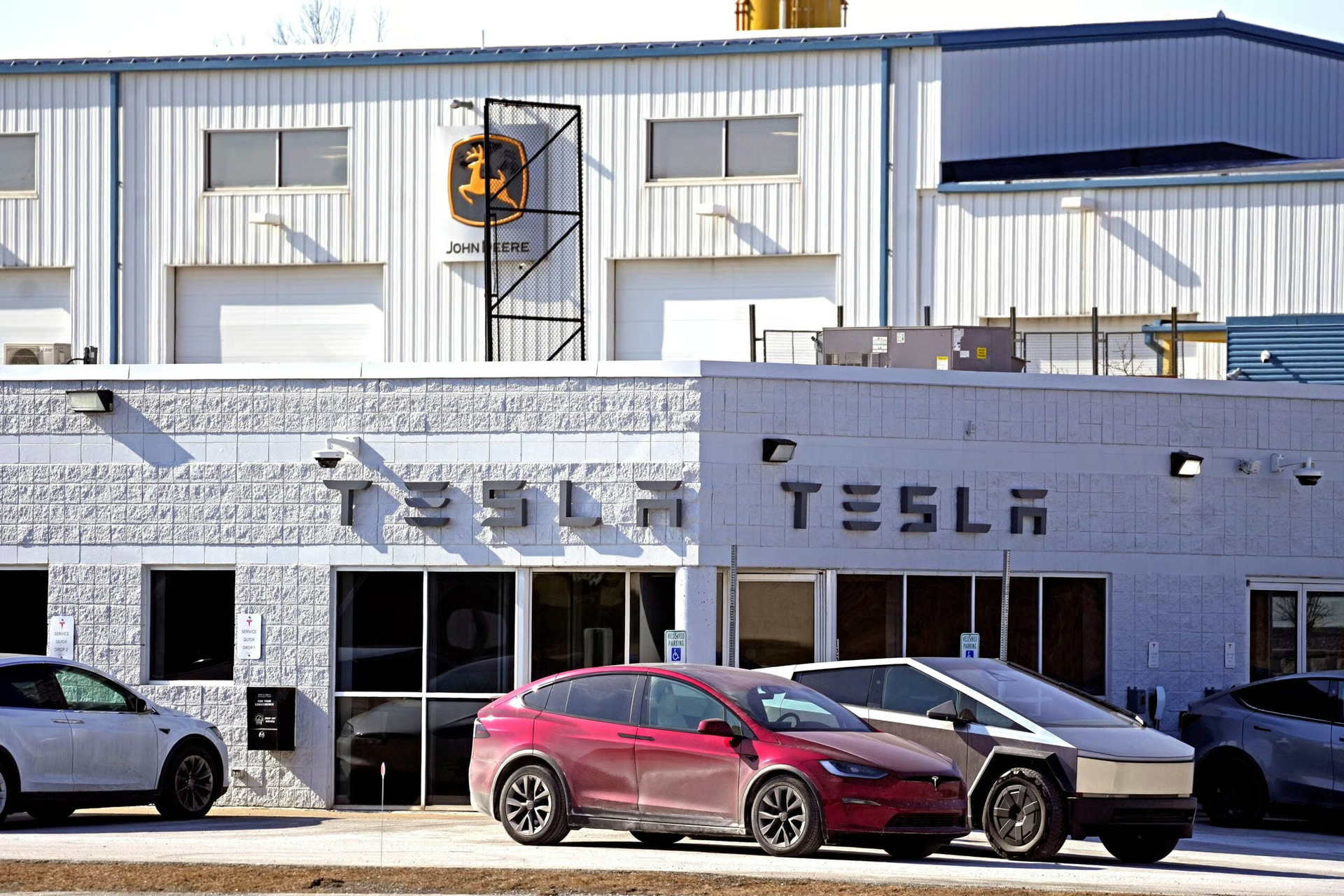
Tesla owners whose cars run on its 2019 Hardware 3 system may have to trade in their vehicles to experience the company’s unsupervised full self-driving mode, CEO Elon Musk told investors as his company reported first-quarter earnings on Wednesday, April 22.
Why can’t hardware support 3 unsupervised FSDs?
Tesla’s Hardware 3 is an AI computer that has been installed in its cars since 2019, whose original purpose is to power the company’s full self-drive software. But Musk said the older hardware doesn’t have enough memory bandwidth to run the system properly.
“Unfortunately, Hardware 3 — I wish it were otherwise, but Hardware 3 does not have the ability to achieve unsupervised FSD,” Musk told investors on a live call. “We thought at one point that it would have that, but relative to Hardware 4, it only has 1/8 the memory bandwidth of Hardware 4. And memory bandwidth is one of the key elements required for unsupervised FSDs.”
“This is something that’s needed for AI in general,” Musk said. “If you’re doing an autoregressive transformer, memory bandwidth is the choke point.”
What is Tesla offering Hardware 3 owners?
For customers purchasing FSD, Musk outlined two options: a discounted trade-in on a car with Hardware 4, or a hardware upgrade – but the upgrade requires replacing both the onboard computer and cameras.
“So for those customers who purchased FSD, what we’re offering is essentially a trade-in — like a discounted trade-in for cars with AI 4 hardware, and we’ll also provide the ability to upgrade the car to replace the computer. And unfortunately, you also need to replace the camera to go to Hardware 4,” Musk said.
Musk acknowledged that the system for upgrading older cars would be challenging, requiring “micro factories or small factories in major metropolitan areas” because service centers alone would be too slow and inefficient.
“So we basically need multiple production lines to make the change,” Musk said. “And I think, over time, it would make sense for us to convert all Hardware 3 cars to Hardware 4 because that’s what enables them to enter robotaxi fleets and have unsupervised FSD.”
The comments come as Musk is promoting Tesla’s upcoming pivot to producing mostly autonomous vehicles. “Over time, it’s going to make sense for our entire lineup to be autonomous vehicles of different sizes,” he said. “In fact, in the long term, the only manually driven car will be the new Tesla Roadster.”
Is Tesla’s Full Self-Drive really autonomous?
According to the California Learning Resource Network, Tesla’s Full Self-Drive equipped cars are generally considered capable of Level 2 autonomy – not the full autonomy as the product names it.
“Despite its name ‘Full Self-Driving,’ the Tesla FSD is not a Level 5 autonomous system,” the website said in a February 2025 post. “At present, it is generally considered a Level 2 system with advanced capabilities, which is close to Level 3, but does not fully meet its requirements.”
Tesla’s own Model 3 owner’s manual states that Full Self-Driving “requires a fully attentive driver” and warns that drivers “must remain attentive and ready to take charge at all times during Full Self-Driving (supervised).”
What are federal regulators looking at?
NHTSA began an investigation into Tesla’s Full Self-Drive system in October 2024, examining crashes where vehicles with FSD experienced reduced visibility on the road from conditions such as sun glare, fog or wind-blown dust.
NHTSA said it launched an investigation after receiving four reports of such crashes. “In one crash, a Tesla vehicle fatally struck a pedestrian. One person was reported injured in an additional crash under these conditions,” the agency said.
The FSD investigation is one of five currently underway by NHTSA involving Tesla vehicles.
