

Q. How are you assessing the market outlook after the timing and price correction of the last two years?
Since the September 2024 peak, the Nifty 500 has declined about 5%. However, stocks are much cheaper than this headline figure. Valuation measures such as price-to-book (P/BV) and price-to-earnings (P/E) ratios have declined by 25-30% or more, depending on the sector, as earnings and book value have increased despite stable prices. Going forward, the outlook of our house remains positive. Most negative news is already priced in. Even before the recovery caused by the West Asian conflict, a price-price gap had emerged. Valuations that were expensive two years ago have now turned from fair to attractive, reflecting the cumulative impact of tariffs, the West Asia crisis, foreign institutional investor (FII) selling and concerns over the currency and monsoon. The economy is on a recovery path, supported by monetary and fiscal measures. A combination of favorable prices, lower equated monthly installments (EMIs), and higher disposable income from tax cuts, government support and pay commission post-GST 2.0 should boost consumption revival. Balance sheets remain strong across the government, corporate, banking and consumer sectors. Overall, corporate earnings, which have been subdued over the past 18 months, are set to return to low double-digit growth. Thus the margin of safety has increased, as valuations of most businesses have improved while the earnings outlook has improved. Over the next two years, multiples may increase by 10-15%, and thus index returns are likely to be slightly above the long-term average.
Q. How have you managed your fund portfolio amid this correction?
We got adequate value in the market even before the West Asia crisis. We never had any cash and were fully deployed. As a fund house, we now have multiple asset managers. But on the two main aspects of portfolio construction, which are stock selection and portfolio construction, the overall approach remains the same. The emphasis is on quality purchases at reasonable prices. We do not buy quality things at high prices or buy low quality things just because it is cheap. We define quality internally based on two criteria. Growth must exceed nominal GDP growth; The higher, the better. And the pre-tax return on capital employed (ROCE) should be at least 15%. It is almost certain that the bulk of the portfolio should be invested in quality businesses, provided we do not overpay for them. In recent months, the decline in many quality stocks, especially private sector banks, has been not due to any deterioration in fundamentals but largely due to continued selling by FIIs. We are buying these names because we believe high quality businesses are now available at reasonable valuations. It is a major overweight in the portfolio; In other words, we own more of these than the index. There are many other quality businesses that boast high ROE, but are very expensive. Therefore, we give less importance to those names because they do not meet our criteria.
The second aspect is portfolio diversification, where in most of our funds 40-45 stocks constitute 80-85%.
With this template, the long-term lens has a strong chance of outperforming benchmarks and peers. We keep improving the processes to achieve greater stability.
rapid fire
Q. One investing rule you should never break.
Stick to quality stocks and let the numbers speak louder than statements.
Q. A missed opportunity or a bad investment, which haunts you longer?
A bad investment lasts longer – errors of commission, i.e. actual losses, cause more harm than errors of omission.
Q. Are there any previously held assumptions or theories on markets/valuation that are no longer true?
The idea that valuations are at risk and big drawdowns are exclusive to the small and mid-cap segment only.
Q. The most difficult decision you had to take as a fund manager.
The most difficult task for any fund manager is to identify and act on governance red flags.
Q. If markets could talk, what would they say to investors today?
Maximum money is made when invested in tough times – like today.
Q. A trend or theme that investors are underestimating?
Possibility of mean-reversion in some disliked sectors/stocks including some big blue-chip companies. It’s like solving the easiest question first in an exam.
Q. If your portfolio were a Bollywood film or song, what would its title be?
‘Chak De India’ – a portfolio built on supporting India’s broader growth story as a team effort and not just a few star performers.
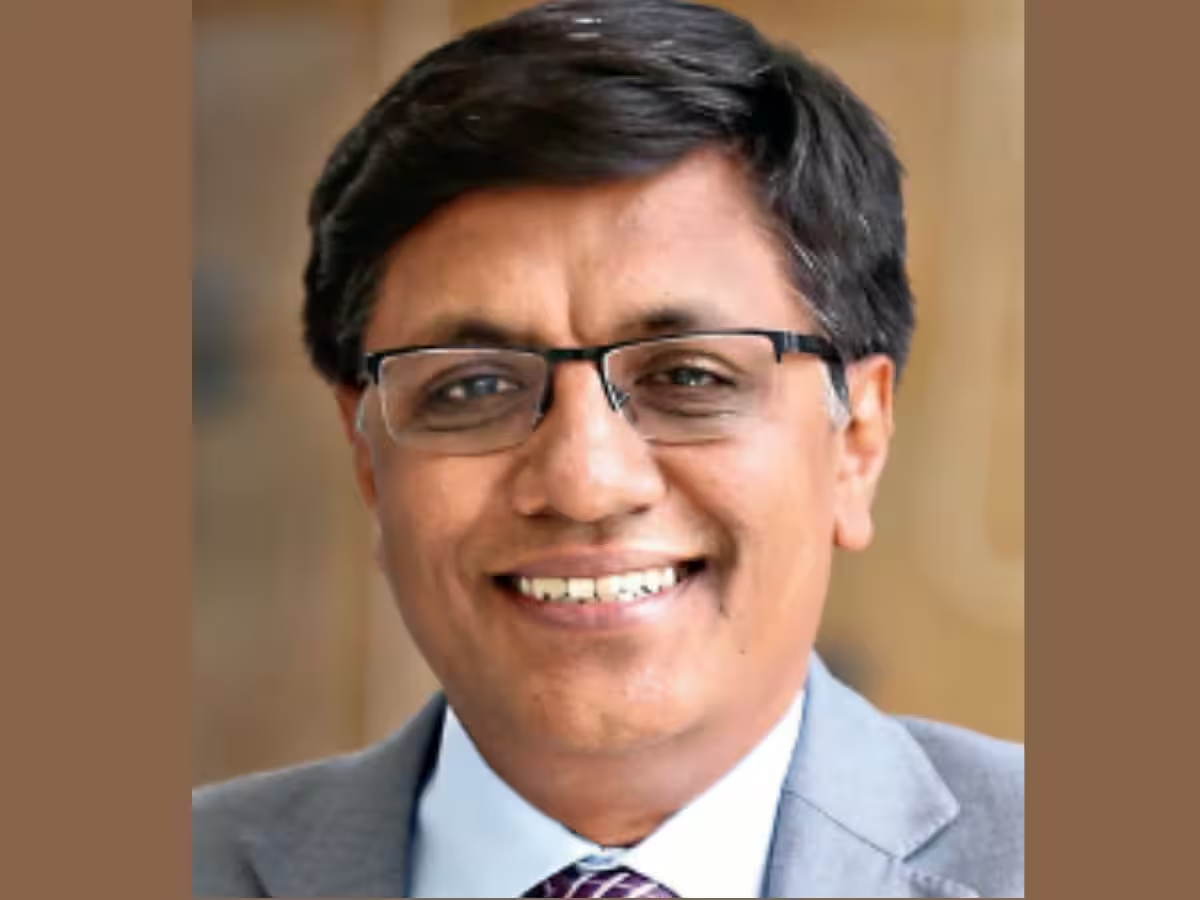
Nilesh Surana
CIO, Mirae Asset Investment Managers
Q. Have your style biases caused you to perform poorly recently?
Market stage and style impact performance. If you remember, 2023 and early 2024 was a phase when the market moved very fast and was not cheap. In such stages, it is difficult to have both consistency of style and continuity of performance. Coincidentally, some of our larger active weights did not perform well over that period. The fact that many of those businesses are now back strongly shows that most of the decline was in stock prices, not the businesses themselves. In other words, the damage was on paper. This was not a permanent error of misallocation in the wrong set of businesses, valuations or management. So, in that context, there was no big learning for us because it was a passing phase. Having said that, there were errors of omission. These were mostly about things we had sold before, which continued to perform well. We are now pursuing a more graded exit. We learned little things about adopting slightly different investing styles within the same template. Most of our equity funds faced recession during this phase. So we went for less coordination across all strategies; Different styles within the overall framework. We also emphasized that portfolio variance within the universe should be slightly higher.
Q. What danger signs are you trying to avoid now?
We are underweight or neutral in two areas: good businesses that are expensive or where growth is uncertain. There are very good businesses in capital goods, infrastructure, defense and electronics manufacturing services (EM), but most of them are expensive. If time/price improves we can consider these later. The second basket includes the consumer base and information technology (IT) services where there are a lot of unknowns. In IT services, we see structurally lower growth over the long term. The valuation is cheap, but we are not very confident about where the sector is headed in terms of AI-led disruption. We are learning and adapting as things go. At the moment, we are slightly underweight in this area. In the consumer sector, we see long-term growth in discretionary rather than staples. Beyond these buckets, we are finding substantial value in most areas. We like private banks, life insurance and oil and gas. Consumer discretionary is not only a strong long-term play but also a near-term positive. Within this, consumer discretionary at the bottom of the pyramid has struggled since Covid-19, whether in footwear or construction materials. But large consumer discretionary items, including automobiles, are in good shape. We also continue to own pharmaceuticals. In that, Contract Development and Manufacturing Organization (CDMO) plays a good part.
Q. What is the risk-reward scenario in market capitalization?
Today there are opportunities in all three areas. Only FIIs have sold heavily in large caps. So, large caps are overpriced and a little cheaper because they are oversold. But an important thing to consider is that many businesses that exist in the mid-cap and small-cap segments are not available in the large-cap sector. So, the first filter should not be of size; This should be the choice of businesses. One third of the businesses are not available in the Nifty basket.
Furthermore, it is a misconception that valuation risk applies only to the small and mid-cap basket. Look at large-cap IT services. I think it is very stock-specific rather than sector-specific. In the long run, you should have small and mid-caps to have a complete representation of different sectors. For example, if there is a shift to the bottom of the pyramid in the next 3-5 years, many businesses that are sector leaders may not even exist in the mid-cap sector. These are no longer small companies. The scale and size of the opportunity has changed dramatically over the last five years. There are a lot of formalities happening in this group. So, we see opportunities in all three areas of the market.
Q. How has your investment framework evolved? Have your views changed in any area?
There is always something to improve in our profession, processes and thinking. But in general, I’ve found that buying quality and not overpaying for it works in the long run. There is a lot to learn along the way. For me, one lesson is that when deciding to sell, it should be classified. If the pace of earnings continues, then what is expensive can become very expensive. Some of these names were in our portfolio a few years ago. Therefore, if earnings momentum is sustained, sales should be phased out over time. In portfolio creation, we’ve fixed the way we categorize businesses. For example, the investment side of the economy, including capital goods or defence, was not part of the benchmark until 7-8 years ago. In the index, they were barely 2-3%, but collectively they were a huge chunk. They were distinguished as separate professions, but not identified as broader disciplines. We reclassified these businesses, which helped us identify which sub-segments would perform well if economy investment performed well or if consumer exports performed well.
Q. This market correction This has fueled stories that retail systematic investment plans (SIPs) deliver substandard results.
SIP creates the right mindset for wealth creation: It takes time. In a growing economy, equities will build wealth over time. SIP is a non-emotional decision. In a lump sum, the same amount can carry emotional weight. Investors become short-sighted and feel anxious. SIP is more disciplined. This creates rigidity in asset allocation. This works well in stable or falling markets, but you only see its benefits when the market is rising. The benefits of whatever you accumulate during the global financial crisis, taper tantrum, demonetization or Covid-19 in the form of higher units become apparent only later. It is good that investors understand that SIPs work better during recessionary times. This can be understood only by experiencing it. When you have a bad couple of years, a lot of theories come up and the negative side is magnified. Equity is a better asset class, but there is no guarantee that you will earn good returns every year. SIP helps normalize these stages over time. Finally, other asset classes have much lower return ranges. In India, interest rates are coming down. Options like fixed deposit (FD) are very effective. The hurdle for after-tax returns in equities is not high.
Q. How do you see the opportunity in Specialized Investment Funds (SIFs)?
We have taken a conservative approach to SIFs, beginning with a hybrid offering, the Platinum Hybrid Long-Short Fund. This will provide better post-tax returns compared to alternatives such as arbitrage funds. This product will have very nominal open equity exposure. This is our flagship product at SIF.
We are in no rush to launch more offerings, such as funds that will take short positions. It depends on what capabilities the fund house brings and the merits of the theme.