

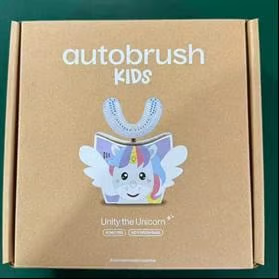
Boxes containing children’s electric toothbrushes have been recalled due to a loose button cell battery, which officials say “could be easily reached by children, posing a swallowing hazard.”
According to a recall notice from the U.S. Consumer Product Safety Commission (CPSC), the recall does not affect the AutoBrush Sonic Pro Kids toothbrush, but rather the box in which the electric toothbrushes were sold.
According to the recall notice, the batteries at the center of the recall are not inside the toothbrushes; Instead, they are kept inside plastic packaging in boxes. The CPSC said the toothbrush boxes fail to warn consumers that they contain button batteries, a legal requirement under Reese’s Law.
“This is not a recall for toothbrushes alone,” Autobrush wrote on its recall page. “Your child’s AutoBrush Sonic Pro Kids toothbrush is safe to use. This recall only applies to the box it came in.”
The CPSC said there were no reports of injuries in connection with the recall.
Which boxes are being recalled?
According to the recall notice, the affected boxes were sold in four different varieties, each of which featured toothbrushes sold as Unity the Unicorn, Lenny the Lion, Harley the Hippo, and Danny the Dino.
The CPSC said the toothbrushes were sold online at TryAutobrush.com between March 2023 and December 2025.
Consumers are urged to throw the boxes in the trash and fill out a form on Autobrush’s website to receive a $5 credit.
What is Reese’s law?
Enacted in 2022, Reese’s Law requires the CPSC to create standards for products that contain button cells or coin batteries, as well as set requirements for warnings and child-resistant packaging.
According to the CPSC, products are required by law to have the following:
- Battery compartments containing replaceable button cell or coin batteries must be secured such that opening requires the use of a tool or at least two independent and simultaneous movements of the hands.
- Button cell or coin battery compartments should not allow such batteries to be accessed or become free as a result of use and abuse testing.
- A warning must appear on the packaging of the entire product.
- If possible, a warning should be marked on the product itself.
- Enclosed instructions and manuals must include all applicable warnings.
