

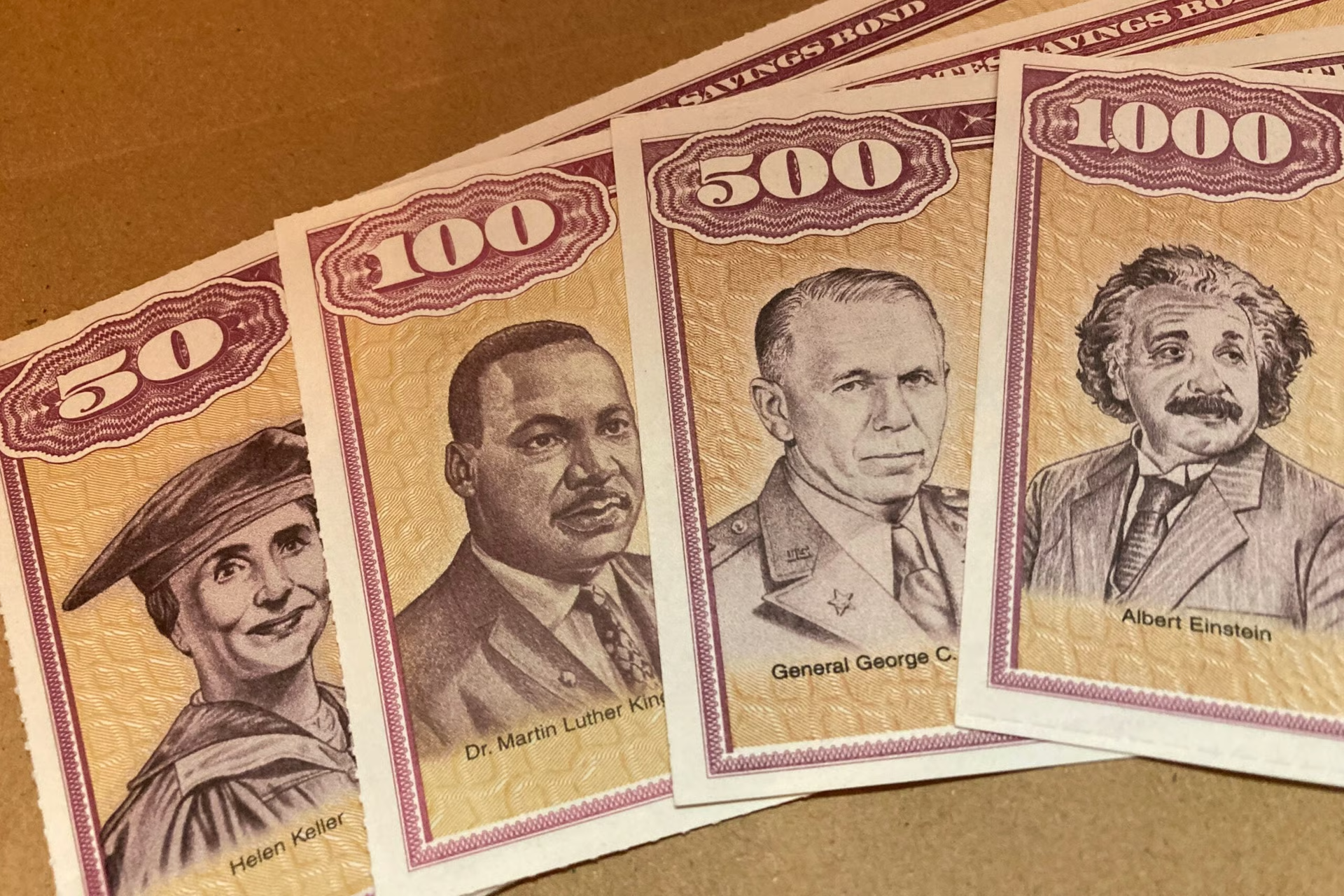
If savers are worried about the latest stock market decline and rise in inflation, they may want to take a second look at I bonds.
Anyone who drives by a gas station has seen how prices at the pump are skyrocketing, and it’s possible that inflation will rise even higher depending on how the Iran war unfolds. The United States and Israel launched unexpected, widespread airstrikes against Iran on 28 February.
The “I” in Series I savings bonds stands for inflation. The idea is to use I bonds to protect savings from inflation. Depending on changes in inflation, the overall interest rate on the bond you bought may go up or down every six months.
I bonds can be used partly as emergency savings, partly as conservative holdings for investors who want to protect some of their portfolio from a dramatic downturn in the stock market.
Inflation reaches its hottest point in 2 years
For several months, I’ve heard from savers who talked more about dumping high-paying I bonds they bought a few years ago than about buying new ones. After all, inflation has fallen significantly since reaching 9.1% in June 2022 – the highest level in 40 years.
And that story might have continued – if we hadn’t got the latest inflation shock.
However, given the latest surge in inflation, savers may want to reconsider selling those I bonds now. And if you need to unload some I bonds, perhaps to cover bills, you’ll want to take extra care to make sure you’re dumping the right bonds.
According to David Anna, who founded Tipswatch.com and regularly tracks inflation-adjusted government bonds, “People were definitely losing interest in I bonds.”
All this has changed in recent weeks, as inflation has increased.
We got our first glimpse of the latest inflation picture on Friday, April 10, when the US Bureau of Labor Statistics released the Consumer Price Index for March.
Over the past 12 months, consumer prices rose sharply by 3.3%. In contrast, the CPI rose 2.4% year-on-year in February.
Gasoline prices rose 18.9% in March over the past 12 months; According to the US Bureau of Labor Statistics report released on April 10, fuel oil prices increased by 44.2% year-on-year.
Gasoline prices rose 21.2% month-to-month.
This sudden increase in inflation – and concerns about future price increases on all types of goods – will soon give inflation-indexed U.S. savings bonds a slight boost.
Ana said, we are talking about an assumed annual rate of 4.26% that will apply for the first six months if the bonds are purchased between May and October.
All I bonds will also benefit from inflationary changes in their rates in the coming months.
For example, rates on I-bonds due 2022 soared and generated so much excitement that even the TreasuryDirect.gov website experienced intermittent recessions during the last-minute rush to buy I-bonds.
The I bonds purchased from November 2022 to April 2023 had an annual rate of 6.89%. This rate applies for the first six months after purchasing a Series I savings bond. The same bond, which has a fixed rate of 0.4%, currently has an annual rate of 3.53% for six months.
Those who keep a close eye on I bonds, like Ana, know that the March CPI, which is released in April, typically provides an essential piece of the puzzle to predict the new rate that will apply to I bonds purchased from May to October.
“March inflation marks the end of the six-month series that will reset the I bond’s variable rate on May 1,” Anna wrote recently. He said the new I bond rates starting in May will be based on non-seasonally-adjusted inflation for the months of October 2025 to March 2026.
New rates for savings bonds are announced every May 1 and November 1.
Why are bond rates going higher?
I Bonds have two components: a fixed rate that remains with the 30-year life of the savings bond and a variable rate that adjusts every six months after the I Bond is purchased. Buy an I bond in June and the variable rate will adjust in December.
Before the Iran war broke out in late February, Anna did not have high expectations for I-bond rates. In fact, he expected a significant decline in interest rates for I-bonds.
Before the Iran war, Ena said he would have told savers with confidence that the convertible rate for I bonds was likely to fall from the current 3.12% to around 2% on May 1. That variable rate matters to anyone who holds I bonds, no matter when they were purchased.
And, again before the war, he said, the Treasury was likely to tinker with the fixed rate, perhaps reducing the current rate from 0.9% to 0.8%. That fixed rate applies over the life of the 30-year bond.
If those projections prove correct, Ana said, the overall rate for I bonds issued from May to October would fall to about 2.81%, down from the current 4.03%.
“After the war broke out, actual yields increased significantly,” Anna said.
“Inflation, obviously, was very high. It inflated all these numbers.”
Now, Ana estimates that the new inflation-adjusted variable rate of I bonds will rise to 3.34% from the current 3.12%. If the fixed rate remains at 0.9%, he is expecting an overall rate of 4.26%, which he now expects it to be for I bonds purchased from May to October – the same as the fixed rate for I bonds purchased from November 2025 to April 2026.
All I bonds will eventually receive a variable annual rate of 3.34% for six months. When the new variable rate starts for individual savers will depend on the original month they purchased the bond.
“Everyone wants to get I-bonds now. The only question is when,” Anna said.
Anna says that many people underestimate how well I Bonds can work for some of their savings, especially emergency savings.
“That cash is just sitting there, ready to be used, but always moving upward with inflation. It’s a super-safe investment,” Anna said.
How do you buy I bonds?
Each calendar year, savers can set aside up to $10,000 per person in electronic I-bonds, which are purchased and held on the federal government’s website called TreasuryDirect.gov.
As a result, I Bond fans try to know the best time during the year to buy I Bonds. They often question whether the fixed rate will go up or down when the rates are announced on May 1 or November 1.
Generally, Anna notes, it makes sense to buy an I bond later during the month because, for example, if you buy an I bond on April 20, you will receive interest for all of April.
Conversely, it is often best to sell during the first few days of the month. For example, if you redeem your I Bond on April 20, you will lose all the interest paid for April.
Going forward, Anna said he sees some possibility that the I bond rate announced on November 1 could have a fixed rate higher than 0.9%, perhaps something in the 1% range or slightly higher.
It is difficult to know how much inflation will increase.
Anna said it would be interesting to see the inflation trend for the next six months.
“We are in a new era of inflation. It is hard to predict and even harder to tell where we are headed,” Anna said. He admits that even before now he has always had difficulty predicting inflation.
However, inflation is now clearly back on everyone’s radar.
“Inflation is high and will accelerate this year as energy and other prices rise because of the Iran war,” Mark Zandi, chief economist at Moody’s Analytics, told the Detroit Free Press, part of the USA TODAY Network.
Inflation, as measured by the personal consumption expenditure price index, is currently near 3%, and will approach 4% later this year, Zandi said. The Federal Reserve’s inflation target is 2%.
Zandi expects inflation to rise due to higher energy prices, the ongoing impact of higher tariffs, and the expansion of AI, which many expect will initially contribute to inflation.
When it comes to I bonds, there is still a small window to buy in April before the new rate comes into effect – say on or around April 28.
An investor who buys I bonds in April will get a six-month annual return of 4.03% and then 4.26% for the next six months, Ana said. In that case, he said, you could get an estimated 4.16% over 12 months.
However, remember, the I Bond fixed rate may be reset on May 1, and we will not know until the Treasury makes an official announcement.
What to consider if you are selling I bonds
If you are considering selling some I bonds, review the rates you can get on those particular bonds.
Paying attention to the fixed rate on I bonds is something that novice savers don’t think is necessary. After all, who would imagine that you would need a very detailed chart to explain which fixed rate applies to which batch of I bonds issued when? Yet such a chart exists online.
In a strange twist, I bonds can have all kinds of fixed rates that apply over the 30-year life of the bond, depending on when you bought it.
The first I bonds, issued in September 1998, continue to have a fixed rate of 3.4%. I bonds purchased from May 2000 to October 2000 have a fixed rate of 3.6% – the highest fixed rate ever for an I bond.
At the other end, we’ve got a long list of I bonds issued in various years that have a fixed rate of 0%.
For example, the 0% fixed rate applies to long-term I bonds purchased from May 2020 to October 2022. In that case, you are only getting the variable inflation rate for any six-month period.
In contrast, the I bonds issued from November 2023 to October 2024 had a fixed rate of 1.3%.
Ideally, if you are planning to cash out some I bonds, you might consider selling the batch with a 0% fixed rate and holding onto the bonds that will continue to pay a fixed rate, no matter where inflation is.
If you sell an I bond before you have held it for five years, you are facing a nominal penalty.
If you redeem the I-Bond in less than five years, you lose the last three months of interest. The TreasuryDirect.gov site gives an example: “If you cash the bond after 18 months, you get the first 15 months of interest.”
After five years, Ana said, the interest penalty is removed and you can cash out at any time.
Redeeming a savings bond will mean that most people will have to report all interest earned on the bond during the year they redeem the bond. For those redeeming large amounts of bonds, it may be important to review your tax situation, perhaps speaking to a tax professional first.
“You will have to pay tax when you redeem,” Ana said.
Ana is personally selling her I bonds, which have a 0% fixed rate, to reinvest in I bonds that have a higher fixed rate.
“I don’t have any of those left, but I do have some 0.1% and 0.2% versions that I can roll over,” he said.
The threat of inflation remains real – especially when you consider that oil derivatives are found in everything from medical devices to textiles and furniture. And more online ordering means almost everything will be delivered – which can drive up all kinds of prices.
Inflation hurts on many levels. But I-bonds may have a new lease of life as they provide a way for savers to get some protection from inflation.
Contact personal finance columnist Susan Tompor at: (email protected). X Follow him on @tompor.
