

President Donald Trump promised “Drill, baby, drill” during the presidential campaign.
It’s not going to get him out of this oil crisis Lawmakers and analysts say it is motivated by the war he started in Iran.
Trump and Republicans aggressively pushed fossil fuel-friendly policies last year after securing election victory in 2024 on promises to lower the cost of living, including lowering gas prices.
His signature domestic policy bill, known as “a big beautiful” tax and spending measure, opened the way to new land for oil and gas leasing. The administration has moved to reduce regulations that the fossil fuel industry views as hindering. And it has adopted an aggressive leasing program to operate more rigs on federal lands and waters.
Now, Trump is facing a crisis from which he has no prospects of getting out. The war in Iran has hit oil markets hard as the Strait of Hormuz remains largely impassable. The strait carries about 20% of the world’s oil supply. The US is unlikely to rapidly increase drilling to fill the void, analysts and lawmakers say.
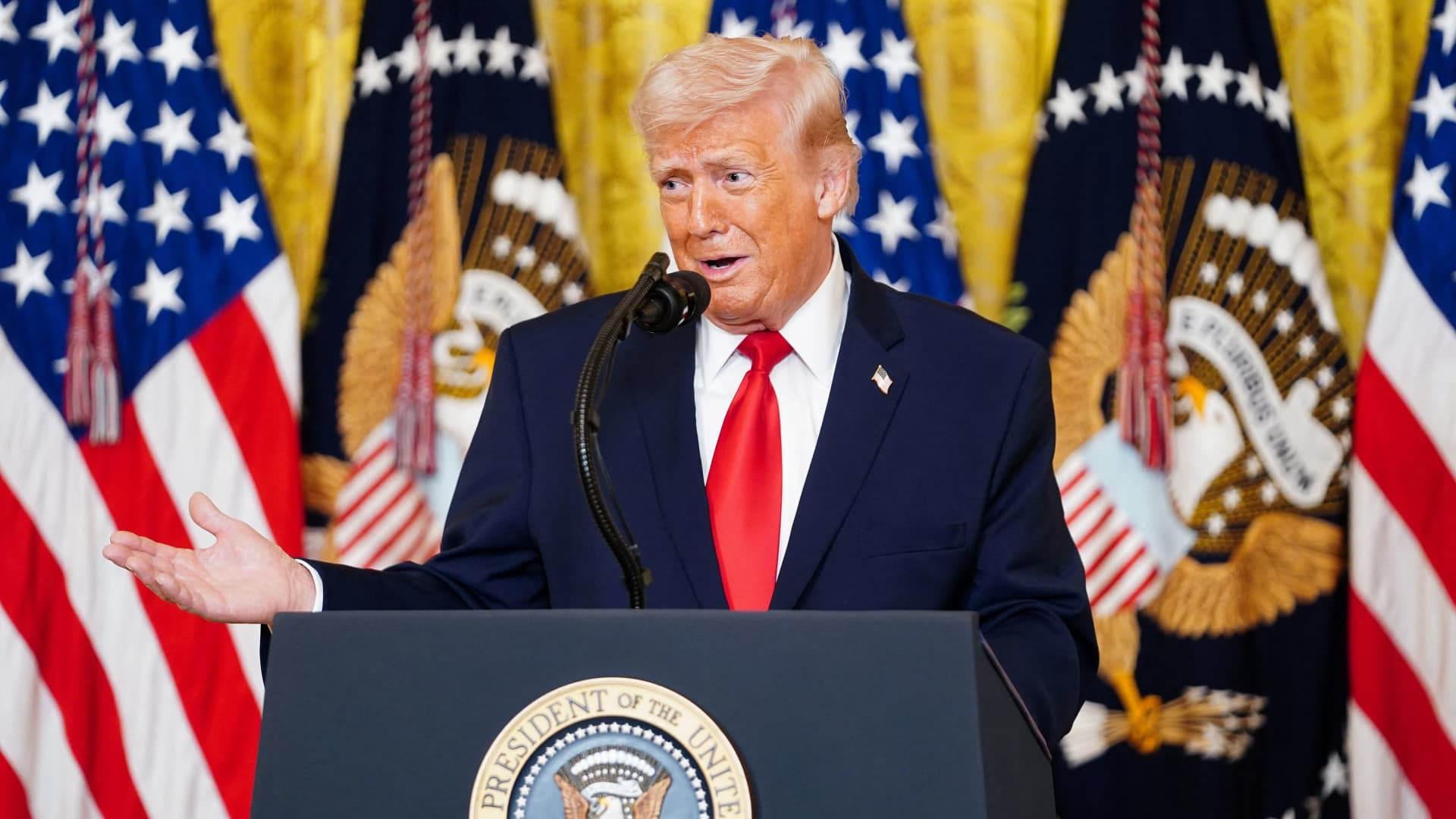
US President Donald Trump speaks during a Women’s History Month event in the East Room of the White House on March 12, 2026 in Washington, DC, US.
Nathan Howard | reuters
“No, not the quantity,” said Sen. Martin Heinrich, D-N.M., ranking member of the Senate Energy and Natural Resources Committee. “I don’t care what you do with strategic petroleum reserves or drilling, you can’t make that kind of volume.”
“You’re still going to see a big impact on gas prices no matter what. How long it will take for it to get back to normal will be several months,” Heinrich said in an interview.
The phrase “Drill, baby, drill” was popularized by Sarah Palin, vice presidential candidate on John McCain’s Republican ticket in 2008. In the nearly two decades since, it has been a Republican rally slogan, and Trump used it at his rallies in the 2024 presidential campaign.
Palin, who was governor of Alaska, advocated drilling in her state and the Gulf of Mexico. New York Times reported There were no bidders this month for a bid by the Trump administration to open Alaska’s Cook Inlet to new offshore oil and gas exploration.
According to December data, the US currently produces about 13.7 million barrels of oil per day Energy Information Administration. Last week the US refined about 16 million barrels of oil per day.
Oil is also beholden to global market conditions, which is why the closure of the Strait of Hormuz has been so disruptive. The strait carries about 20% of the world’s oil, and the world demands more than 100 million barrels per day.
“What matters is overall supply and demand, and with what’s going on in the Middle East right now, it’s going to remain unbalanced for quite some time,” Heinrich said.
Analysts agree. Brian Prest, an economist and fellow at Resources for the Future, a nonpartisan research group that focuses on natural resources, said it is not possible to drill domestically the amount of oil needed to offset the closure of the Strait of Hormuz. This is despite excessive production in the US for the past several years.
“You would really need to see a huge increase in U.S. production for this to appear as a meaningful percentage of total global supply,” Perst said. “The US has seen a huge increase in oil production over the last 15 years, but the situation is the same; it took 15 years.”
“I can’t imagine that you’re going to see a huge bounce from the U.S. alone that is going to balance the market during the war, which they expect will last for a few weeks,” Perst said. On Saturday the war reached its two-week milestone.
A foreign tanker carrying Iraqi fuel oil is damaged after it caught fire in Iraq’s territorial waters, following unidentified attacks targeting two foreign tankers, near Basra, Iraq, March 12, 2026, according to Iraqi port officials.
Mohammed Ati reuters
There are also signs that US oil producers are not planning to increase oil and gas production rapidly to take advantage of skyrocketing prices. At the beginning of the Russian invasion of Ukraine, oil prices skyrocketed. And while the U.S. rig count increased modestly, leading to a price bounce, the U.S. total increased. crude oil production Maintained a steady upward trend since 2010.
Much of that growth has been driven by technological advances in drilling, particularly horizontal drilling and fracking, which have significantly increased production in places like the Permian Basin in New Mexico and Texas — not a fire sale of new potential drilling.
Even Republicans, who have spent large parts of Trump’s second term promoting “energy dominance” and “energy independence”, acknowledge that more drilling will not get the US out of the oil crisis in the short term.
Senator John Hoeven, R-N.D. Said that the increased oil and gas drilling that the Trump administration is trying to promote will bring down prices in the long run, but the priority now is to open the Strait of Hormuz to bring prices down.
“The key in the near term will be how this dynamic plays out on the Strait of Hormuz,” he said in an interview. “If it’s covered well, even if there is a perception that it drags on for a while, it is minimized.”
“In the long term, as we continue to grow … and we continue to increase that number over time, it will actually depressurize the oil market, make prices cheaper and we will become even less dependent on the Middle East,” Hoeven said. “But it’s a long period of time.”
As of now, the strait is effectively closed, despite the Trump administration trying to find passage for ships. And oil markets, despite falling for a brief period this week after Trump suggested the war could soon end, continue to rise.
US oil futures closed at more than $95 on Thursday. And brentGlobal indices surged above $100 as Iran’s new supreme leader said the Strait of Hormuz must remain closed.