

“An enigma, wrapped in a mystery, within a enigma.” This is how Winston Churchill famously described Russia (the then Soviet Union) in 1939.
To this day, I can’t think of a better way to describe the complexities when trying to understand Russia, its leadership, and its motives. A puzzle was once again reinforced for me last week during my first conversation with a senior Russian official since the country’s invasion of Ukraine in 2022.
Before Russia’s invasion and annexation of Crimea in 2014, I frequently visited Russia and witnessed its post-Soviet integration into the global system.
From the G8 meetings in St. Petersburg to the G20 in Moscow; From appearing multiple times at the St. Petersburg Economic Forum, to sitting in the palatial Kremlin with oil industry leaders and the powerful Igor Sechin as my host; I had seen how Russia seemed to be on the Western economic path.
And yet all that was rapidly destroyed after the Crimean invasion, which I witnessed firsthand from Kiev, where I was reporting from in early 2014.
Fast forward 12 years and all that cooperation is over. Russia, heavily sanctioned and ostracized by the West, was still in a bloody feud with the West over Ukraine and distrust was as great as at any point in the Cold War after World War II.
So, while my first conversation with a top Russian official in many years was always going to be an awkward moment for me, I have had the privilege of talking to many top Russian and Ukrainian leaders in my career.
my trip to the embassy
In fact, there was something unique about the whole experience of my visit to the Russian Embassy in London to talk to Ambassador Andrey Kelin.
At times it felt as if I was in a parallel reality, some kind of universe separate from the dire reality of the current twin geopolitical crises engulfing Europe, the Middle East, and potentially the world as I have understood it to date.
For starters, there was the setting for our conversation. My team and I were invited to the official residence of the Russian Ambassador at 13 Kensington Palace Gardens, also known as Harington House – without a doubt, one of the most beautiful houses in one of the most beautiful streets in the most beautiful part of London.
Inside, I walked through a stunning wood-paneled atrium into an equally stunning main reception room known as the Golden Room. In the same room, my team was preparing for our interview with our counterparts from the Russian Embassy. Our four cameras were matched with the Russian team, creating an ‘eight camera shoot’ – a record for at least four cameras for me.
The Golden Room was decorated with stunning art by many Russian artists, front and center were two beautiful marine scenes by Ivan Aivazovsky.
From the Golden Room, I was shown to the adjacent Green Room and then the Winter Garden, an orangery where former British Prime Ministers Churchill, Anthony Eden and Harold Macmillan were entertained, whose photographs adorned the room.
Looking towards the back garden, a pleasant young diplomat pointed to a small grassy knoll. He smiled and said, “That’s the old World War II bomb shelter, where legend has it that Ambassador Fedor Gusev and Churchill escaped during a night raid and hid in a well-stocked emergency basement. Although that may just be a legend.”
The setting, the impeccably polite young diplomats attending to our every whim – overall, the Russians were perfect hosts, and yet I had to remind myself that these were representatives of the same government that had been ostracized and sanctioned by the West for provoking the largest conflict on European territory since World War II.
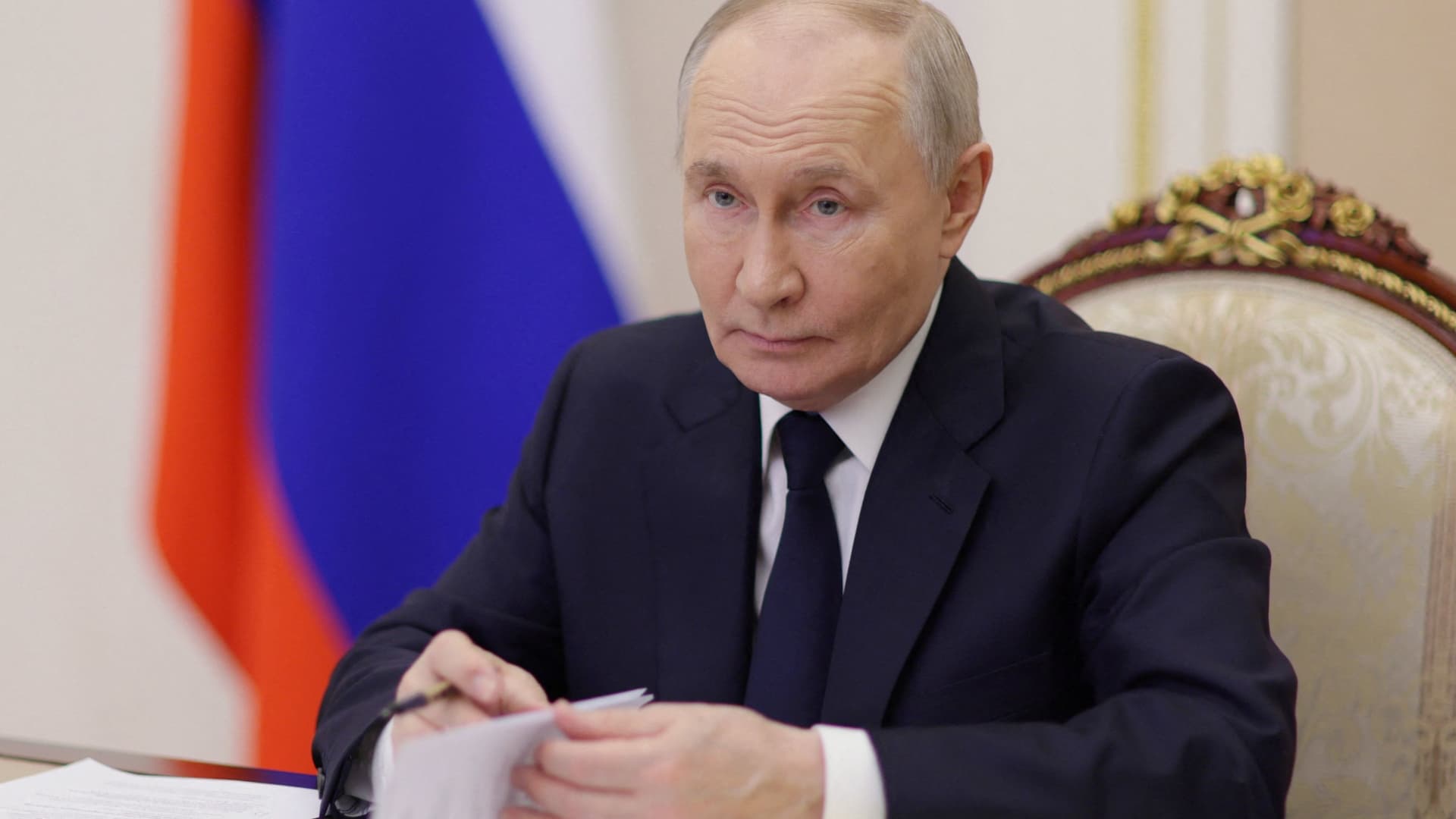
Russian President Vladimir Putin chairs a meeting with members of the government via video link in Moscow, Russia, March 4, 2026.
Gavriil Grigorov via reuters
Representatives of President Vladimir Putin, who appear to be on a mission to reconquer the Soviet-era sphere of influence for Russia, which has claimed hundreds of thousands of deaths and possibly millions of injuries since a full-scale invasion of Ukraine in February 2022.
A few minutes later, I sat down for my interview with Ambassador Kelin, a 68-year-old career diplomat who has been Moscow’s man in London since late 2019.
Like his attentive team, Kellin was polite and articulate. He answered every question I asked directly and yet, I realized very quickly in our 40-minute interview, that whatever big-picture view he gave, I had previously heard, in one way or another, from Putin, Kremlin spokesman Dmitry Peskov, and others, about the roots of the conflict and how Ukrainian President Volodymyr Zelensky and his European supporters were an obstacle to some form of peace deal.
I pushed back, telling him that it was Russia that had invaded Crimea, that it was Russia that had broken the 1994 Budapest Memorandum guaranteeing Ukraine’s sovereignty, and that it was Russia’s maximalist demands that were the biggest obstacle to a peace agreement.
At each point, Kelin refuted my version of the facts and stuck to well-repeated lines blaming the EU, the West generally, and NATO for moving into Russia’s sphere of influence and preparing the material for the upcoming 12 years of conflict.
Also on Iran, Kellin refused to accept that Iran’s pursuit of highly enriched uranium (presumably to make some kind of nuclear weapon) was the root cause of the current conflict.
On the subject of whether Russia was actively supporting Iran – former Foreign Minister Vyacheslav Molotov once said that Russia “will not be indifferent to its fate” – Kelin refused to confirm any support, claiming that as a “civilian” he had no knowledge of the matter.
I can’t blame the ambassador for not answering any of my questions. He was a generous host and yet, I left our long interview with very mixed feelings. It was a good day from a journalistic point of view. I think both journalist and interviewer had a strong, direct and, I hope, respectful conversation about the most important topics of the day.
However, my hopes for consensus for progress toward ending the bloody European conflict after our meeting were not aroused. I felt like little had changed after 12 bloody years. The lack of understanding and commonalities that would have ended the war was not at all visible, despite the Ambassador’s stated hopes that the war would end this year.
Once again, Russia and the West were talking – but in completely different languages. To both, each other’s motives appeared to be mysteries, puzzles and riddles.
