

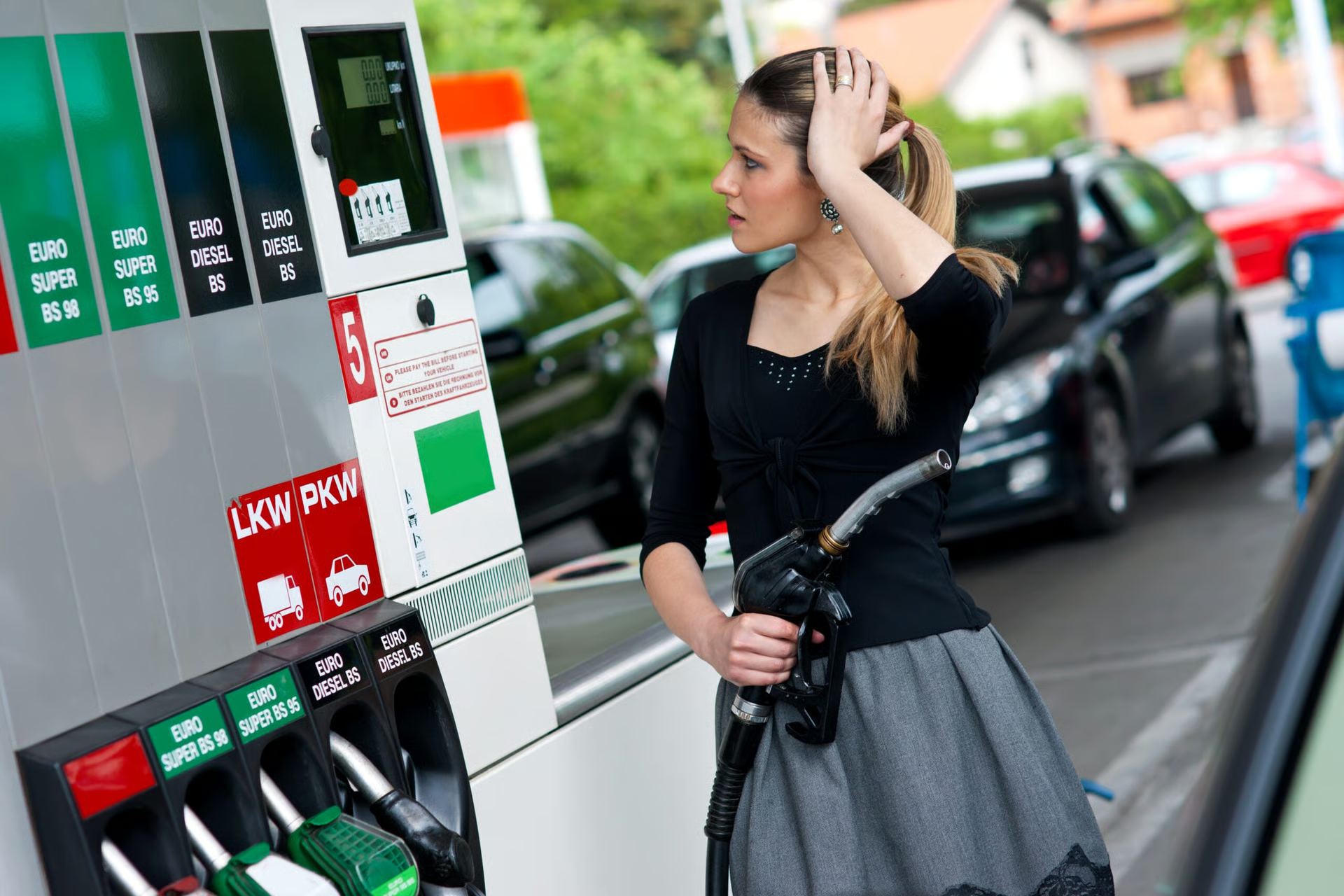
You’ve seen it hundreds of times. Oil prices rise, and overnight, the number on the gas station sign goes up as if it were on a trampoline. Then oil prices fall – and you wait. and wait. And wait some more until the pump price comes.
This is not your imagination. You are not going crazy. This is a documented, decades-old economic phenomenon. And yes, this applies to anyone filling the tank.
But is this pure greed? The answer is more complicated and more frustrating than you think. Here are five reasons why this keeps happening.
1. It’s a real thing, and economists have a name for it
Economists call this “rockets and wings.” When costs rise, prices rise like rockets, but when costs fall, they float down like feathers.
The term has been around since 1991, when British economist Robert Bacon first published research documenting the pattern. Since then, UC Berkeley economist Severin Borenstein and others have confirmed the asymmetry with decades of data.
This is not a marginal theory. The Federal Trade Commission has studied it several times. according to FTC researchRetail gas prices rise nearly four times faster than they fall. This is not a small difference.
And this is not just an American problem. Researchers have found the same pattern in the UK, Germany, France, South Korea and Colombia. This happens wherever people buy gas.
2. Your local gas station isn’t getting rich off of you
Here’s something that might surprise you: The gas station owner makes almost nothing on fuel. The net profit on a gallon of gas is about 3 to 7 cents. That’s a profit margin of less than 2%.
To put this in perspective, the banking industry’s profit margin is around 30%. Your gas station owner is closer to a grocery store than a bank.
So why do prices rise so rapidly? Because when wholesale costs increase, station owners are unable to absorb the hit. They will sell at a loss within a few hours. They have to raise prices immediately or go bankrupt.
But when wholesale prices fall, there is no rush. They have already bought fuel at a higher price. That inventory held in their underground tanks was paid for yesterday, at yesterday’s price. Next, they will lower the prices after buying a cheaper load.
This is not a conspiracy. This is cash flow.
3. You stop paying attention when prices fall
It’s on us, the consumers.
When gas prices go up, you get angry. You start looking for the cheapest station. You’ll run an extra mile. You should check out GasBuddy. You compare each symbol on the block.
But when will the prices fall? You rest. You stop shopping here and there. You reach whatever station is convenient for you.
The FTC identified this as the dominant explanation for the disparity. consumers Discover more at bargain prices When prices are rising. This forces stations to compete aggressively and match each other along the way.
On the way down, no one is watching. Therefore, there is less competitive pressure on station owners to reduce prices rapidly. Why be so quick to cut into your already razor-thin margins when customers aren’t around to shop?
Economists call this “asymmetric search behavior.” I call it human nature.
4. The supply chain is a one-way conveyor belt
Crude oil does not magically transform into gasoline as soon as the price changes on the trading floor. There is a supply chain, and it moves in one direction – slowly.
Crude oil is refined. The refined gas is sent to regional terminals. Terminals distribute it to different stations through tanker trucks. Each step adds time.
When oil prices rise, traders and refiners immediately raise prices. Futures contracts are adjusted in real time. That signal moves rapidly through the chain, as everyone along the way seeks to protect their margins.
But when prices fall, there is no urgency. Refiners have already bought crude at the old price. The wholesaler has inventory. The station owner has a tank full of gas purchased last week.
Everyone is sitting on the product for which they overpaid. They are not going to sell it at a loss because crude oil has fallen this morning.
The US Energy Information Administration estimates that crude oil typically accounts for about half of the retail price of gas. Federal taxes add 18.4 cents per gallon. State taxes and fees average 33.55 cents. No matter what oil does, those fixed costs don’t go down.
And it’s not just gas that feels the wave. Oil prices affect everything from airline tickets to grocery prices.
5. Competition works harder as it moves forward
Gas stations are in a strange competitive situation. They sell almost identical products, often across the street from each other. And their prices are displayed on huge signs for everyone to see.
When costs rise, no station wants to be the last station to raise prices. If your competitor raises his price and you don’t, every car on the street pulls into your station. You will sell your tank at the old, loss-making price within a few hours.
So stations race against each other to reach the top. This is self-preservation.
When costs fall, the dynamics change. If you’re the first to cut your price, you attract more customers – but at a lower margin. Meanwhile, your competitor across the street keeps higher prices a little longer and makes more profit per gallon.
There is no incentive to be the first to move downwards. Every day you wait for your price to drop is another day of slightly better margins.
So is this greed? no way
Is the system rigged against you? Not in the way you probably think. This is not a backroom deal between oil companies and gas stations.
It is the collision of economics, human behavior and supply chain mechanics. Low margins force stations to raise prices rapidly. Your own purchasing habits allow them to gradually reduce prices. And the physical reality of moving oil from a well to your tank means there’s always a lag.
This does not mean that you are powerless. You can still compete by being alert when prices are falling. Keep using apps like GasBuddy. Keep comparing. The more consumers buy during falling prices, the more pressure stations feel to cut prices sharply.
And you can save real money at the pump by taking steps that have nothing to do with oil prices – like filling up your fuel on the cheapest day of the week or changing some driving habits that are draining your tank.
The game is not fair. But at least now you understand the rules.