

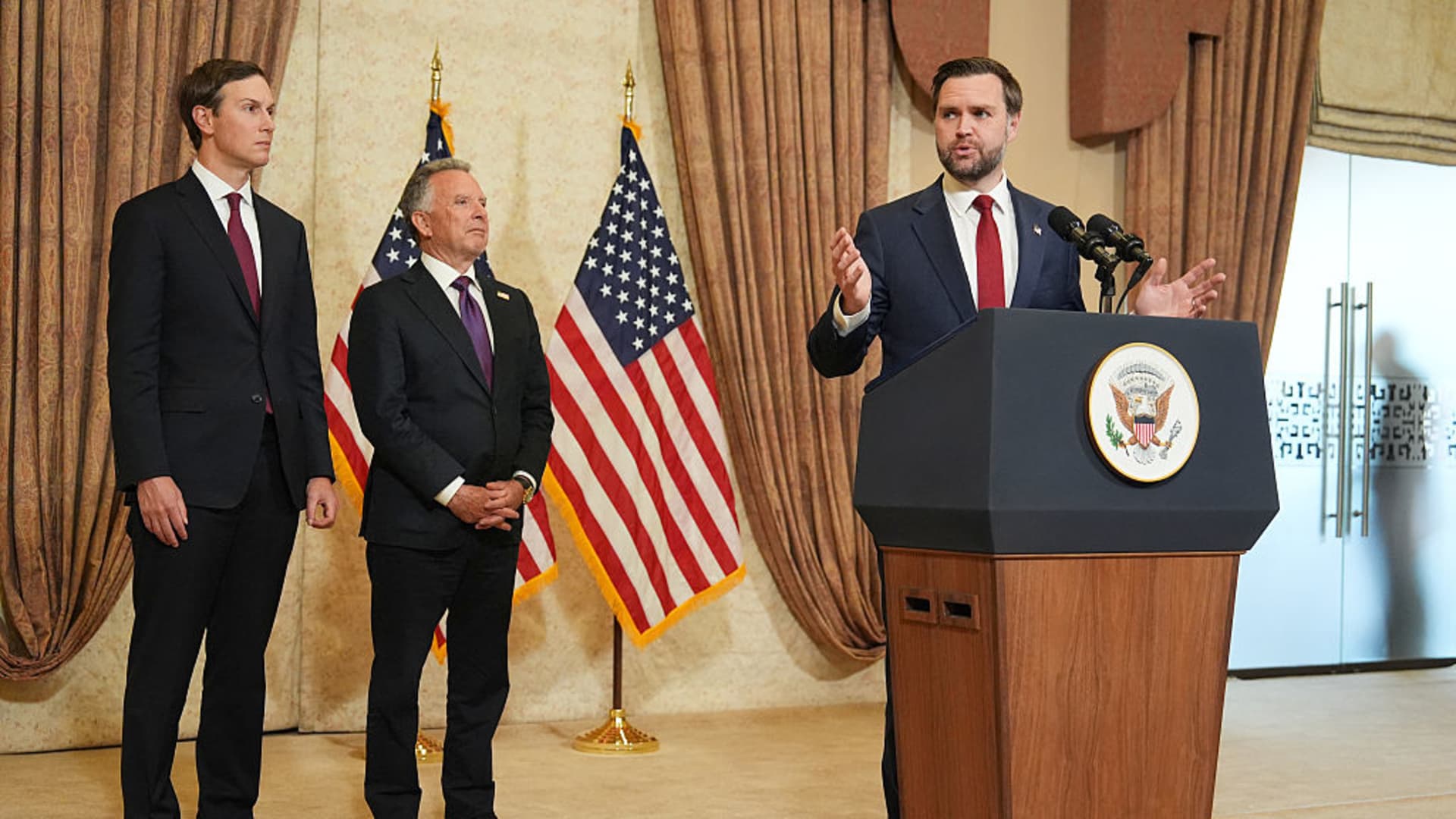
US Vice President JD Vance (R) speaks during a press conference after meeting with representatives of Pakistan and Iran, as US President Donald Trump’s son-in-law Jared Kushner (L) and US Special Envoy to the Middle East Steve Witkoff (C) look on in Islamabad, April 12, 2026.
Jacqueline Martin AFP | getty images
Vice President J.D. Vance said Monday it is up to the Islamic Republic to take the next step on peace talks with the United States, after returning from failed talks with Iran over the weekend.
“Whether we have further negotiations, whether we ultimately reach an agreement, I really think the ball is in the Iranian court, because we’ve put a lot on the table,” Vance said in a Fox News interview.
He emphasized that if America’s “red lines” on Iran’s nuclear ambitions are met, “then it could be a very, very good deal for both countries.”
The comments came hours after the US blocked ships from entering or exiting Iranian ports in the Strait of Hormuz in what President Donald Trump has described as an effort to pressure Tehran’s leaders to return to the negotiating table.
The blockade was announced shortly after US negotiators walked away from peace talks in Islamabad without reaching an agreement to end the war.
The aim was to force Iran to reopen the strait, a vital route for oil shipping whose de facto closure during the war had sent global energy prices soaring.
“We can’t allow any country to blackmail the world or extort money, because that’s what they’re doing,” Trump said of Iran on Monday.
“We need to see the Strait of Hormuz completely open. And that, frankly, is one of the things where the Iranians tried to move the goalposts during the negotiations,” Vance told Fox.
The fragile 14-day ceasefire with Iran, which began last week, was partly based in Tehran Vance agreed to reopen the strait.
“But we have not seen it fully reopened. So our expectation is that the Iranians will continue to make progress toward opening the Strait of Hormuz, and if they don’t, it will fundamentally change our interactions with them,” he said.
He said the blockade puts “additional economic pressure” on Iran.
All of America’s “red lines” for a peace agreement stem from the position that Iran can never have a nuclear weapon, the vice president said.
Washington and Tehran could not reach a final agreement, Vance said, on two of Trump’s non-negotiable issues: removing Iran’s enriched uranium from the country, and implementing verification measures to ensure they cannot obtain nuclear weapons.
Vance and the US negotiating team of Special Envoys Steve Witkoff and Jared Kushner made progress with Iran during the Islamabad talks, the vice president said.
“They moved in our direction, so I guess we’d say we had some good signals. But they didn’t move very far,” he said.
“And so the decision we made, you know, given that we don’t think this current team and this current timeline is going to be able to get a deal done, let them go back to Tehran, we’re going to go back to Washington, and that’s where we are today,” he said.
Asked if more talks were in the pipeline, Vance said, “That’s a question that would be best put to the Iranians, because the ball is really in their court.”
“I think there’s really a great deal to be done here,” he said, “but I think it’s up to the Iranians to take the next step.”
“The President wants the Iranian people to move forward and succeed. He has presented a serious proposal to his negotiating team,” Vance said. The ball is in Iran’s court. Did we make progress? “Yes, but we’re going to find out from the Iranians whether we can make that final progress that gets us to a bigger deal.”