

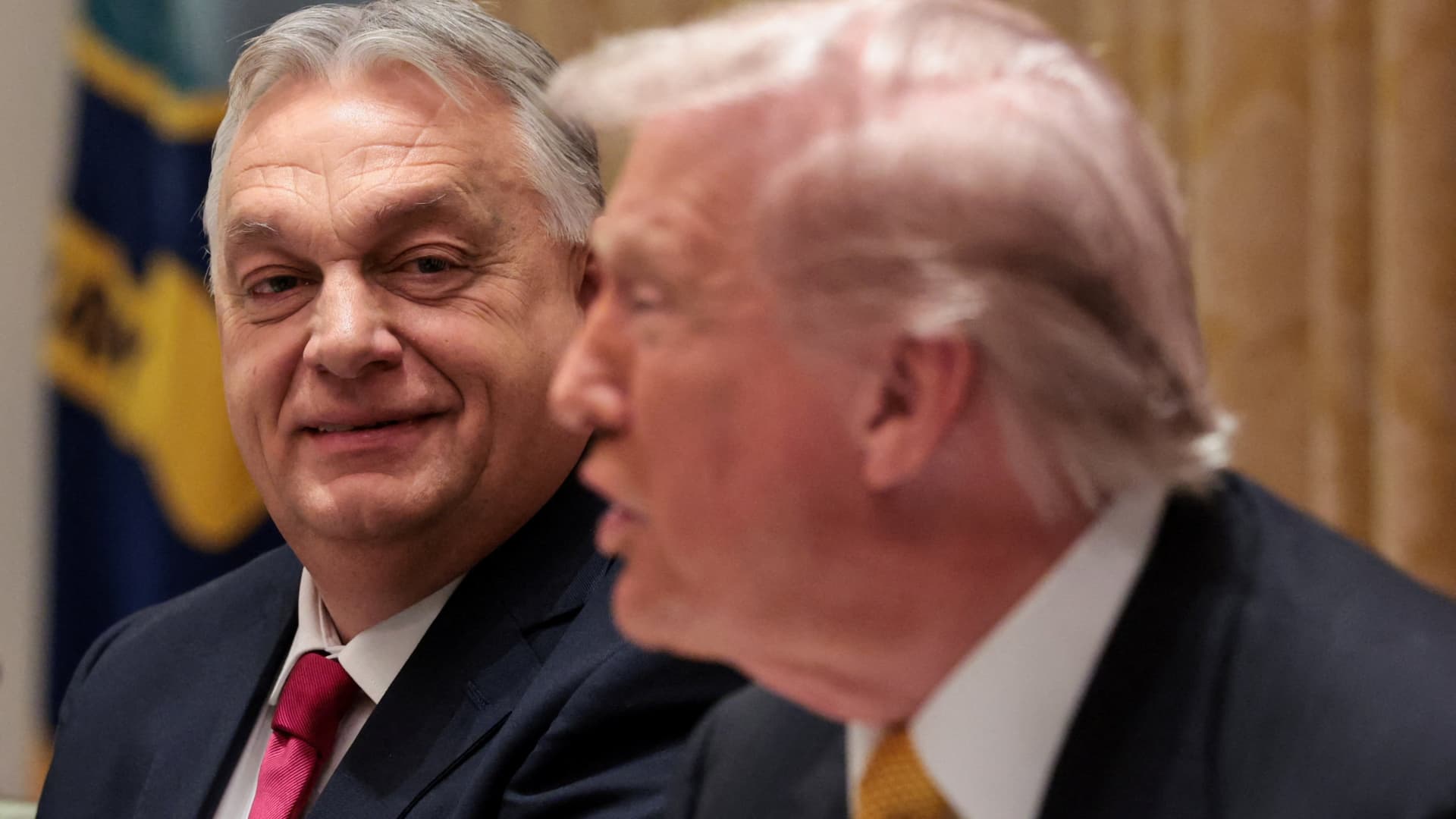
Hungarian Prime Minister Viktor Orban attends a bilateral lunch hosted by US President Donald Trump at the White House in Washington, DC, US on November 7, 2025.
Jonathan Ernst | reuters
Hungarian Prime Minister Viktor Orban has the “full and complete support” of US President Donald Trump – but he is on the brink of losing the country’s election, which is shaping up to be one of the most important and controversial elections in Europe this year.
On Tuesday, US Vice President JD Vance will arrive in Hungary to pledge his support to Orban and address an election rally at a football stadium in Budapest ahead of Sunday’s elections. While other European leaders have explicitly aligned themselves with Ukraine in the war against Russia, Orbán has maintained comparatively close ties with Russian President Vladimir Putin. He even said in the campaign that the EU is a bigger threat to Hungary than Russia.
The latest polls show Orban and his Fidesz party are set to lose to their main rival, the pro-European opposition party Tisza, whose leader, Peter Magyar, is set to replace Orban after 16 years in power.
This would be a significant change in a country where discussions have been dominated by concerns over migration, sensitivity to high energy prices, corruption and violations of the rule of law.
Those violations led the European Commission to suspend EU funds to the country – about 17 billion euros worth of funds are still frozen.
Magyar said unlocking the money would be his “top priority” and indicated he was open to pursuing closer ties with the EU, including potentially adopting the euro.
In an interview with The Associated Press over the weekend, Magyar said that “compromising” was an “art.”
He said, “The world seems to be overtaking Europe. Europe has lost its competitiveness. Europe does not have strong enough leaders. There are no visionary leaders and Europe is lagging behind.”
Lawyer and former government insider Peter Magyar speaks to people at a demonstration held in front of the Prosecutor General’s Office in Budapest, Hungary on March 26, 2024.
Janos Kummer Getty Images News | getty images
An analysis by the German Marshall Fund said Magyar’s premiership could mean a departure from the confrontational foreign policy pursued by Orbán – and it could also bring Budapest closer to its Western allies on other issues, such as unity against Russia.
But a potential Magyar government would not represent a clear break from Orbán-era policies.
Migration remains a controversial issue – and so does support for Ukraine. Tisza has taken a cautious stance on Ukraine’s EU ambitions – and even supported Orban’s government in the European Parliament by voting against sending troops or weapons to the frontline.
Energy also remains a complex issue. Hungary is currently embroiled in a dispute with Ukraine over oil deliveries through the Druzhba pipeline, which led Budapest to veto a 90 billion euro loan from the EU.
In recent weeks, Orbán has focused on allaying fears of an energy price shock stemming from the war in Iran. He accused the Magyars of conspiring with the EU and Ukraine to cut Hungary off from cheap Russian oil.
The election campaign has also been closely monitored for any potential outside interference from Russia, with a particular focus on reports of misinformation on social media.