

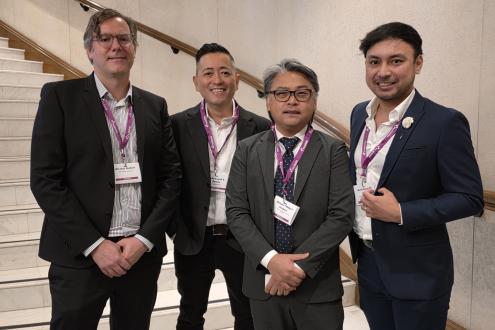
At the Hubbis Philippines Wealth Management Forum 2026, industry professionals examined how investment advice is evolving in response to increased market volatility, greater global connectivity and rising client expectations. The discussion focused on the shift from product-led engagement to portfolio-driven advice, the growing importance of diversification and offshore exposure and how firms are building scalable advisory frameworks while maintaining client-centric delivery.
Chair: Nicolas Gisbert, Head of Sales, Southeast Asia and Head of Strategic Partnerships Asia, Morningstar Research
speakers
- Bede Lowell S. Gomez, Chief Investment Advisor, EastWest Bank
- Michael “Mikko” Vergara, Head of Equities and Global Funds, Sun Life Investment Management & Trust Corporation
- Mark Giron de Mesa, Head of Wealth Solutions, Philippine National Bank
key takeaways
- Investment advice has decisively shifted from product-based conversations to portfolio construction and goal-based frameworks.
- Global diversification and offshore allocations are increasingly embedded in client portfolios.
- Market volatility has reinforced the importance of disciplined asset allocation, risk management and wealth preservation.
- The integration of active and passive strategies is evolving as companies optimize risk-adjusted returns.
- Technology and AI are driving advisor scalability, while human advisors remain at the center of interpretation and client alignment.
From product distribution to portfolio-based advice
Panelists emphasized that the consulting landscape has changed significantly over the last three to four years. In contrast to the post-pandemic environment – characterized by abundant liquidity and return-seeking behavior – today’s market conditions are defined by geopolitical uncertainty, inflationary pressures and more complex risk dynamics.
As a result, the advisory conversation has moved away from product selection to overall portfolio construction. Rather than focusing on returns in isolation, advisors are increasingly aligning investment strategies with client objectives, time horizons and risk tolerances.
“The discussion now starts with goals and risk alignment before introducing any product,” said one panelist.
This shift reflects the broader maturity of the Philippine wealth market, where structured advisory structures are beginning to replace transactional engagement models. Portfolio construction is no longer seen simply as a technical exercise, but as the central mechanism through which client outcomes are delivered.
Back to basics in portfolio construction
In an environment marked by persistent volatility, panelists highlighted the need for a renewed focus on core investment principles. Diversification, balance and disciplined asset allocation are once again at the heart of the advisory framework.
Rather than adopting aggressive, return-driven strategies, companies are increasingly adopting a more measured approach focused on wealth preservation and risk management. The portfolio is being structured across multiple asset classes – including equities, fixed income, commodities and alternatives – to ensure flexibility in varying market conditions.
“There is a clear move away from chasing returns toward more stable, risk-aware portfolio construction,” said one panelist.
This approach also reflects a change in customer mindset. Investors are becoming more receptive to gradual, long-term wealth accumulation strategies, as opposed to short-term, high-volatility opportunities.
Globalization of customer portfolio
A key structural change identified in the discussion is the increasing internationalization of customer portfolios. Historically, Filipino investors have displayed a strong domestic bias, with their assets largely denominated in pesos and concentrated in local markets.
However, this is changing rapidly. With allocations to global equities, multi-asset strategies and thematic investments becoming more prevalent, companies are actively encouraging offshore diversification.
“Clients are increasingly recognizing that domestic exposure alone is insufficient for long-term portfolio flexibility,” said one panelist.
This change is not only enhancing return potential but also improving portfolio risk characteristics. Exposure to international markets can reduce volatility and improve risk-adjusted returns, especially when combined with targeted geographic allocation strategies.
Rethinking active and passive allocation
The panel also explored the emerging balance between active and passive investment strategies. While active management remains important – particularly in less efficient markets – there is growing recognition of the role of passive strategies in increasing portfolio efficiency.
In practice, many firms are adopting a hybrid approach, using a passive allocation in developed markets while deploying active managers in areas where alpha opportunities are more evident.
“The combination of active and passive strategies allows better control of risk while maintaining return potential,” said one panelist.
This integrated approach reflects a more sophisticated understanding of portfolio construction, where the focus is on optimizing overall results rather than favoring a single investment style.
The emerging role of options and private assets
The demand for alternative investments is gradually increasing, especially among more sophisticated customer segments. While structural barriers still limit full integration into traditional portfolios, interest in private equity, private debt and other alternative assets is growing.
These investments are being viewed not only as sources of diversification, but also as potential drivers of increased long-term returns – especially for clients with longer investment horizons.
“The appetite for more entrepreneurial forms of investing is growing, especially among the next generation of clients,” said one panelist.
In the Philippine context, this trend is still early, but momentum is growing as both clients and institutions become more familiar with the asset class.
Scaling Advice Through Frameworks and Technology
A central challenge for wealth managers is to deliver high-quality advice at scale. Panelists highlighted the importance of establishing strong advisory frameworks covering asset allocation, risk profiling and model portfolios as a foundation for scalable delivery.
These structures enable companies to efficiently serve a wide customer base ranging from mass affluent to ultra-high-net-worth segments. However, differentiation is achieved through how the advice is given.
“The framework provides stability and scale, but delivery must be tailored to each customer,” said one panelist.
Technology, particularly AI, is playing an increasingly important role in this process. Rather than replacing advisors, AI is enhancing their capabilities – streamlining research, summarizing information and enabling more efficient client engagement.
“AI shifts the value of an advisor from information gathering to interpretation and application,” said one panelist.
Personalization at scale – balancing design and delivery
The discussion also highlighted the increasing importance of personalization. Clients are expecting advice that reflects their individual priorities, constraints and long-term objectives.
To address this, companies are taking a dual approach: standardizing core advisory frameworks while optimizing delivery for high-value segments. This allows scalability without compromising the specialized nature of high-net-worth advice.
This model is particularly relevant as companies expand their coverage across customer segments, requiring differentiated strategies for mass affluent, high-net-worth and ultra-high-net-worth individuals.
The future of investment advice
Looking ahead, panelists believed advice will continue to evolve toward deeper, more structured customer engagement. Portfolio-based advice supported by disciplined asset allocation and augmented by technology is expected to become the industry standard.
At the same time, the human element of advice remains important. While technology can improve efficiency and scalability, the ability to interpret information, contextualize strategies, and build trust will continue to define successful advisors.
One panelist concluded, “Advisership will remain fundamentally human, but will increasingly be enabled by technology.”
As the Philippine wealth market matures, firms that can combine strong investment structures, global diversification capabilities and scalable advisory models are likely to be best positioned to meet the growing needs of clients in an increasingly complex investment landscape.