

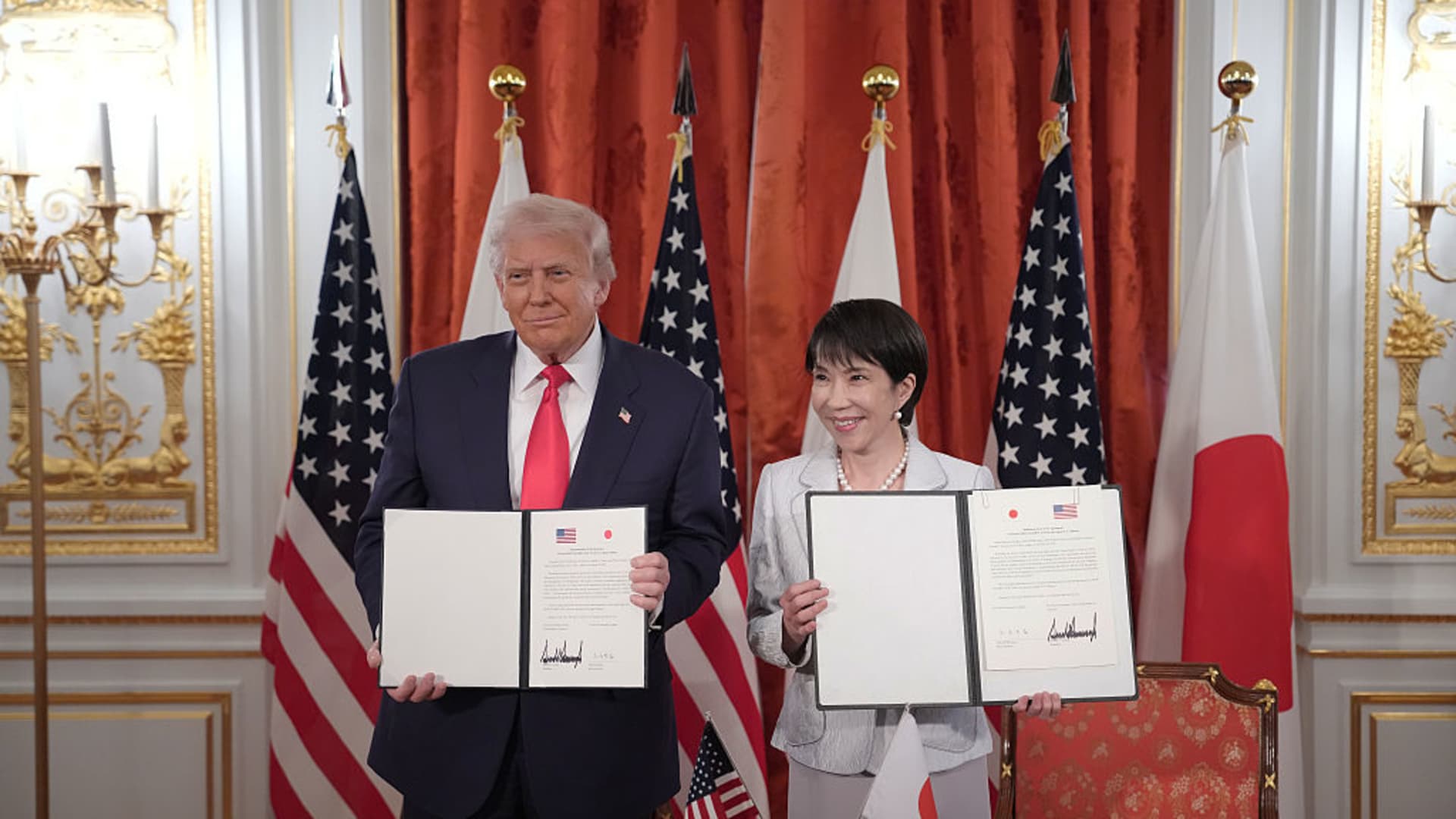
US President Donald Trump (L) and Japanese Prime Minister Sanae Takachi (R) hold signed documents for a key minerals/rare earth deal with Japan during a meeting at Akasaka Palace in Tokyo, Japan on October 28, 2025. Trump is on a trip to Asia that will include an ASEAN summit in Malaysia, followed by a visit to Japan and South Korea before the APEC meetings.
Andrew Harnik | Getty Images News | getty images
As Japan’s Prime Minister Sanae Takachi travels to Washington for her first summit with US President Donald Trump, the Iran conflict will have a major impact on their meeting.
Thursday will mark the Japanese PM’s first meeting with Trump since leading the ruling Liberal Democratic Party to victory in February, its biggest election victory since World War II.
“Takaichi will do what all Japanese prime ministers do, reaffirm that the Japan-US alliance is a cornerstone of Japan’s security, but also for the peace and stability of a free and open Indo-Pacific region,” Stephen Nagy, a professor of politics and international studies at Tokyo’s International Christian University (ICU), told CNBC over email.
But experts told CNBC that the topic of Iran is likely to dominate the meeting.
Iran conflict
Takachi’s meeting was expected to talk about Japan’s investments in the US, increased defense spending and the now-postponed summit between Trump and Chinese President Xi Jinping, before clashes with Tehran erupted on February 28. That’s according to Jeffrey Hornung, Japan head of the national security research division at US-based think-tank RAND.
Hornung said in a phone interview that the original plan was to come “bringing gifts” that showed Japan was a very forward-leaning partner both in defense and economically. “But the big uncertainty is how much the war in Iran will dominate the president’s thinking that day?”
“I think it would be hard not to talk about Japan contributing in some capacity, given that it depends on the strait for more than 90% of its oil imports.”
Jeffrey Hornung
Japan Lead, National Security Research Division, RAND
In a true social post, The US President called on allies, including Japan, to help secure the Strait of Hormuz, justifying that this would benefit them more than Washington. So far, no country has publicly committed to supporting Trump’s efforts.
“I’m demanding that these countries come and defend their territory, because this is their territory. This is where they get their energy from. And they should come and they should help us defend it,” Trump said.
Takaichi told the Japanese Parliament The government is considering what can be done within the framework of Japanese law, according to public broadcaster NHK on Tuesday, though it also said it would put national interests first.
Prime Minister’s Office also said in a post on x That “no specific request has been made to Japan on behalf of the United States to send ships.”
Takaichi too reportedly said on Monday There were no plans to send naval ships to protect boats in the Middle East.
“I think it would be difficult not to talk about Japan contributing in some capacity, given that it depends on the strait for more than 90% of its oil imports,” Hornung said.
Under its constitution, the Japan Self-Defense Forces (JSDF) are permitted to use force only to defend Japan.
However, since 2015, Japan has reinterpreted its constitution to allow Limited ‘collective self-defense,’ To enable the JSDF to assist the Allies if an Allied attack poses a serious threat to the survival and security of Japan.
“Japan as passive support and protector, yes of course; but Japan as active leader and potential forward aggressor? It’s like asking sacred sumo wrestlers to play American football.”
jasper cole
Expert Director, Monex Group
Asked if Tokyo could accede to Trump’s request, Hornung said it would be a high hurdle, noting that Japan would have to declare an “existential threat” for the JSDF to use force. Tokyo’s current stance is that The Iran conflict is not an “existentially threatening situation”.
The ICU’s Negi seems a little more lenient, saying the issue of sending ships to the Takaichi Strait will be handled “efficiently.” Instead, Japan could agree to a commitment to refueling missions or diplomacy under Trump, among others.
Should Takachi agree to deploy Japanese assets in the Middle East, he would have to pay a high price in political capital, according to Jasper Cole, specialist director at Tokyo-based financial services firm Monex Group.
Takachi is very committed to strengthening and modernizing Japan to become “America’s unsinkable aircraft carrier in Asia,” Koll said in an email to CNBC, and he has public support in this regard, but Japan is not out to show its power in the Middle East.
He said, “Japan as passive support and protector, yes of course; but Japan as active leader and potential forward aggressor? It’s like asking sacred sumo wrestlers to play American football.”
investment on the table
Away from the war, Tokyo’s investments in the US will also be a topic of discussion. public broadcaster nhk Reported on Wednesday The two sides are “in the final stages of preparations” to announce a joint document outlining a potential second round of investment in the US totaling 11 trillion yen ($69.2 billion).
If so, it would follow an earlier $36 billion investment in the US, announced by Trump in February and confirmed by Japan.
NHK said the next round of investment will also include the construction of next-generation nuclear reactors as well as natural gas power plants.
Under their trade deal agreed in July, Tokyo will invest a total of $550 billion in the US in exchange for Trump reducing tariffs on Japanese exports from 25% to 15%. However, those tariffs have been rescinded following a Supreme Court ruling, with Trump imposing a 10% global tariff instead.
RAND’s Hornung said, “If (Takaichi) can get something that definitely says Japan will not face any higher tariffs with the different mechanisms that (Trump) is implementing right now, I think that will be viewed as a victory.”
He said the public in Japan was not supporting the war, and if Takachi could go back to Tokyo without committing Japan to the Middle East or being criticized by Trump, “I think it would be a victory for him.”