

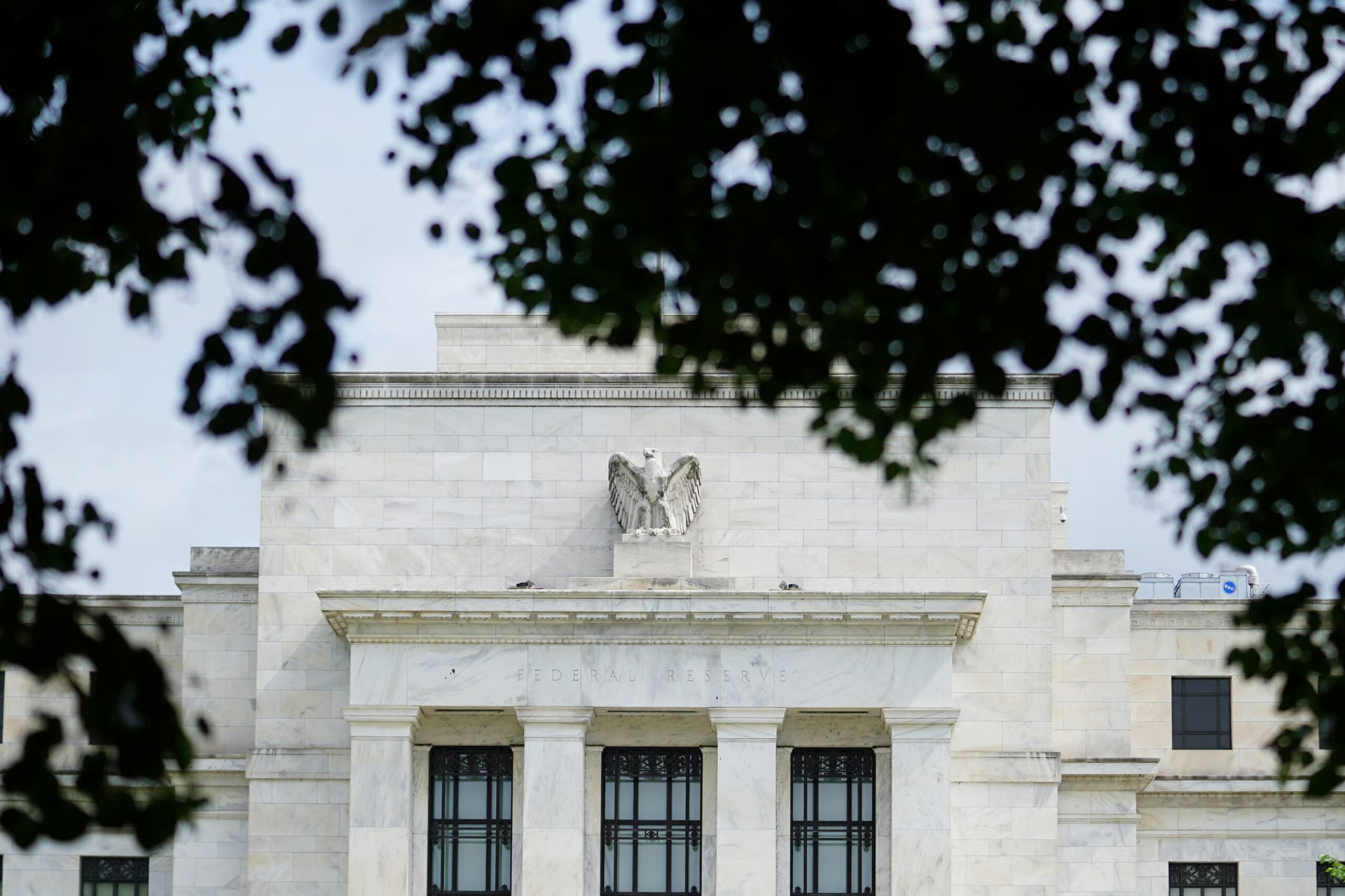
Forecasters widely expect the Federal Reserve to keep its benchmark interest rate unchanged at the conclusion of its two-day meeting on March 18, as policymakers assess the economic impact of the ongoing war with Iran.
Apart from the United States going to war, little has happened since the Federal Open Market Committee held rates steady at its target range of 3.5% to 3.75% at its last meeting in January after three cuts late last year.
The January and February jobs reports from the Bureau of Labor Statistics sent mixed signals about the labor market, with January showing better-than-expected growth and February seeing a decline in jobs. CPI inflation has declined since the last meeting of policymakers, but economists want to look at March data as the latest figures do not reflect the recent surge in oil costs. Rising oil prices can impact supply chains and drive up other prices.
Meanwhile, the Bureau of Economic Analysis revised its estimate for GDP growth in the fourth quarter of 2025 to 0.7%, down from its initial 1.4% estimate, and down from 4.4% in the previous quarter.
Now, fears of stagflation have resurfaced. Wells Fargo economists, in a March 12 note, called high inflation and a weak labor market the committee’s “worst nightmare” as it handles its dual mandate of keeping prices stable and unemployment low.
Where are the job market and inflation?
The BLS reported that the U.S. economy added a now-downwardly revised 126,000 jobs in January, while losing an estimated 92,000 jobs in February. The unemployment rate fell from 4.4% in December to 4.3% in January but returned to 4.4% in February.
CPI inflation eased from 2.7% in December to 2.4% in January and February. This may be a sign that prices are stabilizing under normal circumstances, although it does not reflect the potential inflationary effects of the Iran war. Core PCE, one of the Fed’s favorite measures of inflation, rose 3.1% year-on-year in January, its highest level in a year.
Despite all the developments since the FOMC’s last meeting, Boston College economics professor Brian Bethune said the Fed’s dilemma hasn’t changed.
Bethune said, “Tariffs are a supply shock. Oil prices are a supply shock. Well, guess what? A central banker’s worst nightmare is a supply shock, because you get upward pressure on inflation and downward pressure on employment.” “There’s no easy way out for rates.”
Liz Thomas, head of investment strategy at SoFi, said that if Fed policymakers face sticky or rising inflation and a weak labor market, “they don’t have a tool that can address both of those things, so they have to choose which they want to target.”
What is the economic impact of the Iran war?
Wall Street continues to be shaken by the United States’ decision to go to war. Iran’s control over the Strait of Hormuz – which normally transports about 20% of the global oil supply – has blocked most traffic, driving up oil prices and keeping them volatile.
Much of the economic impact of a war depends on how long it lasts. American consumers are already paying more at the gas pump, and some companies have added fuel surcharges to their prices.
“The futures market is pricing this as a near-term disruption,” said Matt Dyczok, head of fixed income strategy for Bank of America and Merrill’s chief investment office. “This may give the Fed some relief in considering this.”
Bethune said that while tapping strategic oil reserves could help mitigate the shortfall in demand, the easing of sanctions on Russian oil would have little impact on world oil prices.
Bethune said, “Who is Russia aligned with? Iran.” “If Russia provides more support to Iran as a result of greater oil revenues, it will prolong the war.”
Will higher oil prices increase inflation?
Dyczok said that should higher oil prices translate into sustained higher inflation, consumers would need to continue purchasing at the same rate as before, but this typically happens when people feel positive about their job prospects, consumer confidence is high and consumers have healthy savings.
“None of this is true right now,” he said.
Dyczok said, “In our opinion, the tariffs have not caused a massive or sustained increase in inflation because it is a one-time price increase that people adjust to. They buy less of some things.” “It’s possible that a short-term increase in energy prices will do the same thing.”
Bethune said it was understandable that although some price increases due to the tariffs were passed on to consumers, they did not yield the higher inflation levels initially anticipated because implementation was more gradual and subtle than expected. He said companies bore most of the remaining costs by making supply chain changes and making fewer hires, which reduced payroll without significant changes in consumer behavior.
Now, if oil prices remain high, those same companies will face new cost pressures and have few or no options for oil replacement. The question is whether they can again reap productivity gains from a flat workforce, Bethune said, especially amid low income growth.
When will the Fed adjust rates?
Forecasters expect the FOMC to keep its benchmark rate steady at its March and April meetings, increasing the likelihood of a rate cut in the summer.
However, the March decision is not expected to be unanimous, especially after Fed Governors Stephen Miron and Christopher Waller disagreed with the committee’s decision to leave rates unchanged in January.
“Governors Miran and Waller disagree that the labor market is stabilizing and perhaps want to ‘look’ past the supply-side oil shock – a view for which we have considerable sympathy,” Wells Fargo economists said in the note. “But, with inflation entering its sixth year and counting above 2%, there are signs that some hawks on the committee are digging in amid another inflation shock.”
Oxford Economics believes the Fed will cut rates in June and September, reducing core inflation.
The March rate decision will be released along with the FOMC’s summary of economic projections. That quarterly report will include committee members’ projections for the appropriate path for interest rates, as well as their projections for GDP growth, the unemployment rate, and inflation.
Is Powell’s time with the FOMC about to end?
The press conference following the rate decision could be Jerome Powell’s last press conference, as his term as chairman is set to end in May. It is unclear whether Powell will remain on the Fed’s Board of Governors, where his term does not end until January 2028. This is a question he had refused to answer in previous meetings.
The March meeting will be the first since Trump nominated former Fed governor Kevin Wersh to be the central bank’s next chairman. Warsh’s confirmation is stalled in the Senate, with Senator Thom Tillis, R-North Carolina, vowing to block any Fed nomination until the Justice Department’s ongoing investigation of Powell is resolved. On March 13, a federal judge blocked a subpoena issued to the Federal Reserve related to that investigation, although the DOJ plans to appeal the decision.
Chief U.S. District Judge James Boasberg said in his ruling, “The Government has presented essentially zero evidence to suspect Chair Powell of any crime; indeed, its justifications are so thin and unsubstantiated that the Court can only conclude that they are specious.”
On March 13, Tillis doubled down on his stance of blocking the nomination of any new president.
“This decision confirms how weak and frivolous the criminal investigation of Chairman Powell is and what it is, nothing more than a failed attack on the Fed’s independence,” Tillis said in an X-post. “We all know how this is going to end and the DCUS Attorney’s Office should save itself further embarrassment and move forward. Appealing the decision will only delay the confirmation of Kevin Wersh as the next Fed Chair.”
Another legal case involving Fed Governor Lisa Cook is still looming over the central bank. After Trump attempted to fire him in 2021 over allegations he committed mortgage fraud, Cook denied wrongdoing and the case went to the nation’s highest court. The Supreme Court heard oral arguments in January, but has not yet issued a decision.
Reach Rachel Barber at (email protected) and follow her at x @rachelbarber_
This article originally appeared on USA TODAY: Fed to consider interest rates amid Iran war, potential price hikes
Reporting by Rachel Barber, USA TODAY/USA TODAY
USA TODAY Network via Reuters Connect