

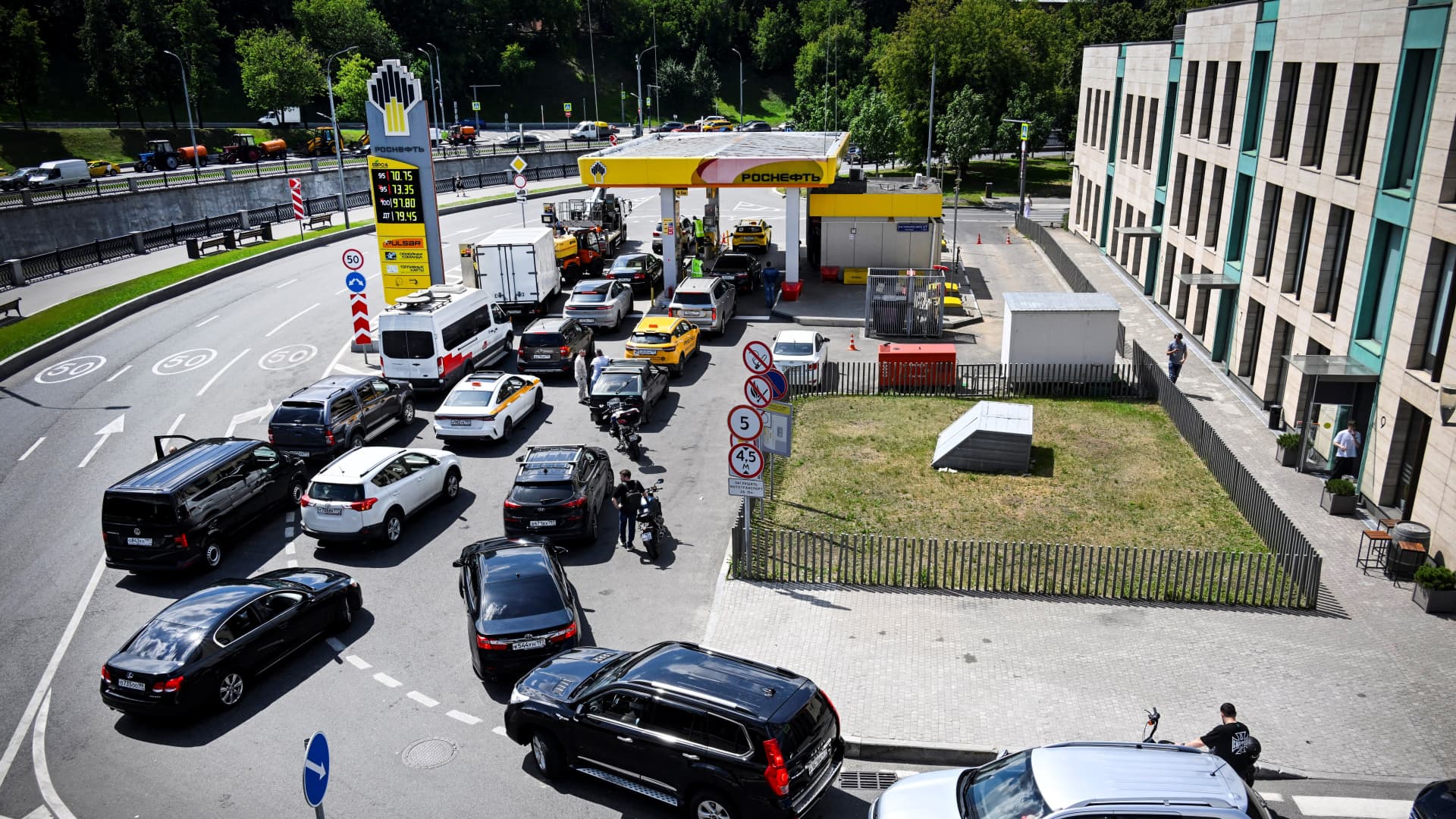
Cars queue for gasoline at the Lukoil gas station in Nakhabino outside Moscow, Russia, on July 8, 2026. Russian cities are facing automobile fuel shortages due to several Ukrainian drone attacks on oil refineries.
Contributor | Getty Images News | getty images
Ukraine has stepped up its attacks on Russian fuel tankers in the Sea of Azov, trying to disrupt supplies to occupied Crimea, after drone attacks have caused gasoline shortages across the country.
Ukraine’s drone force commander Robert Brovdy, known as Magyar, said Telegram 14 Russian ships were attacked in the Sea of Azov on Thursday evening, bringing the number of Russians hit by Ukrainian drones in the past 96 hours to 35. CNBC could not independently verify this report.
The drone strikes are part of Ukraine’s campaign designed to cut off supply and transportation routes in and out of Crimea, which Russia annexed by force in 2014.
Located off the southern coasts of both Ukraine and Russia, the Sea of Azov is a shallow inland sea located northeast of the Crimean peninsula.
Defense experts and strategists have hailed Ukraine’s drone strikes as crucial in curbing Russia’s military momentum, while warning that Kiev’s deep strike successes significantly increase the risk of escalating tensions.
Ukraine has frequently targeted high-profile oil refineries in major cities such as Moscow and St. Petersburg in recent weeks as part of a sustained effort to cut off Russia’s energy revenues.
Earlier this week, Ukraine marked one of the country’s deepest attacks ever on Russian territory in the war.
Plumes of black smoke were seen billowing from a major oil refinery in the city of Omsk on Tuesday, prompting Ukrainian President Volodymyr Zelensky to declare that the country’s advanced drone capabilities had put Siberia “within reach.”
The Omsk facility is located about 2,500 kilometers (1,553 mi) from Ukrainian territory and close to Russia’s border with Kazakhstan.
Russia’s economic situation
Long queues have been seen at Russian petrol stations as the country grapples with a worsening fuel crisis. Actually, the Russian President Vladimir Putin recently acknowledged for the first time the impact of Ukrainian drone attacks on Russian fuel production.
Berenberg’s chief economist Holger Schmieding said that “the costs of war are rising” for the Kremlin.
Russian gross domestic product (GDP) growth stalled in the first quarter, after a sharp slowdown last year and a temporary boost from increased military spending in 2024 and 2023, according to official data.
A man refuels a car at a Gazpromneft petrol station in Moscow on June 24, 2026.
Igor Ivanko AFP | getty images
“While the private sector appears to be shrinking due to labor shortages, shortages of some materials and high interest rates, the military sector continues to flourish,” Schmieding said in a research note published Friday.
He said, “Unless the Strait of Hormuz is closed again for a sustained period, Russia’s economic and financial situation will deteriorate significantly, causing energy prices and Russian export earnings to skyrocket.”