

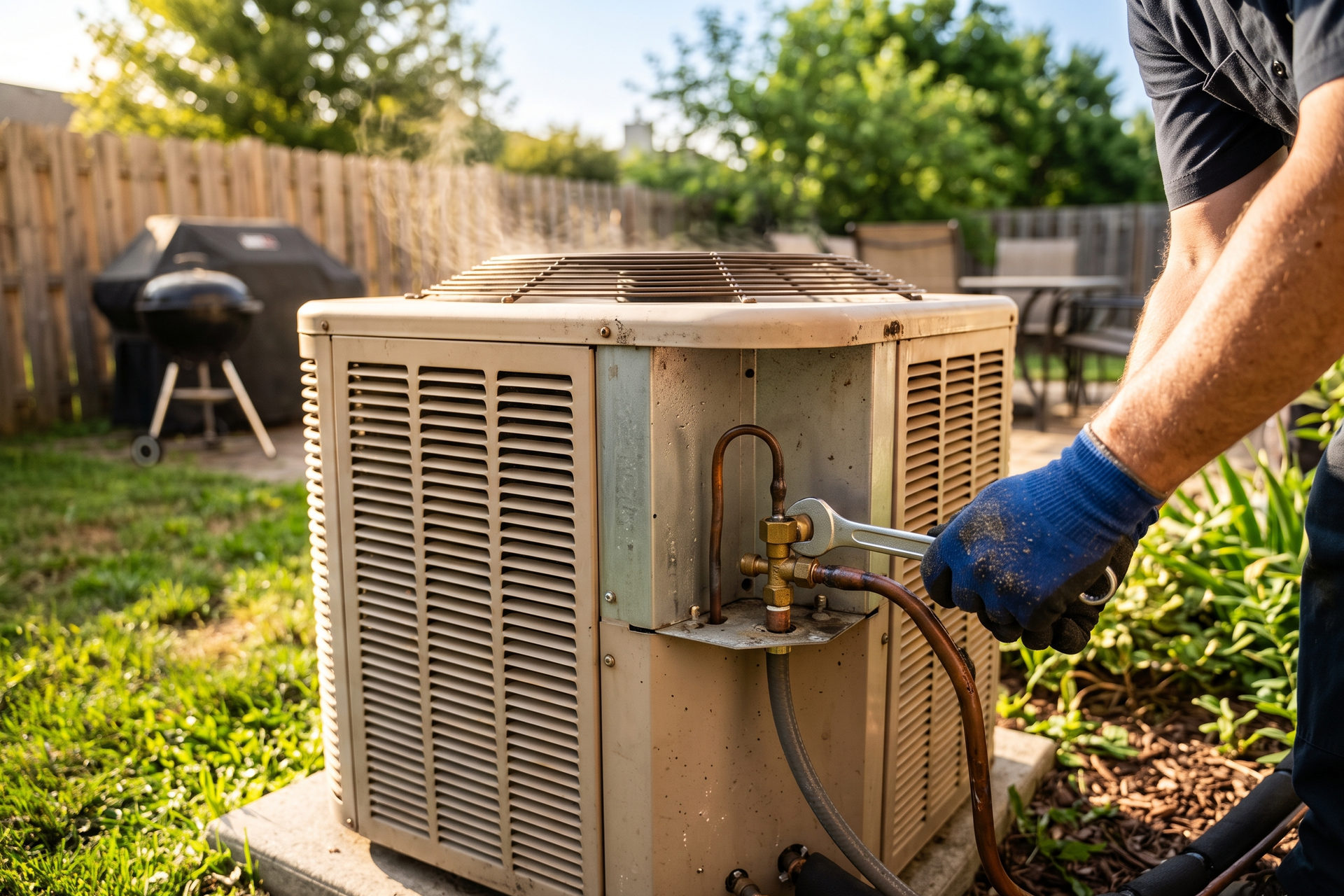
The Fourth of July weekend is one of the worst times for home system malfunctions, and it happens more often than you think. Crowded houses and rising temperatures push HVAC and plumbing systems beyond their limits, and emergency calls increase accordingly.
Cooling failures alone make up nearly a quarter of all after-hours service calls. This is according to a recent SupplyHouse study, which also found that 77% of professionals see that number increase as extreme heat begins. Combine this with holiday rates and fewer technicians on call, and a routine repair can cost two or three times as much as any other day.
Knowing that ahead of time changes the way you prepare. Below, we’ll find out what breaks, what emergency home repairs cost, and how a home warranty can come in handy.
Why do emergency repair calls cost more over the Fourth of July weekend?
By the Fourth of July, most air conditioning units are already working overtime to deal with the extreme heat. “Systems that were previously running slowly are now operating at their highest levels, leading to increased failure of capacitors, controllers, fans and condensers,” says Alex Marsh, CEO of Bearcat Heating & Cooling in Spokane, Washington.
A house full of guests only adds to the stress. “When someone has a house with only two bathrooms but has 30 people over for a barbecue, every system in the house works harder,” explains Tim Fancher, service manager for Smith Plumbing, Heating & Air in Memphis, Tennessee. Toilets flush frequently, disposals run constantly, and taps remain on for hours to fill the kiddie pool or clean the grill.
Any of these costs tend to be higher during the holidays. Companies operate with limited staff and often pay technicians double, increasing homeowners’ bills. It can also be difficult to find parts on short notice, and rising gas prices can increase dispatch charges.
Common Fourth of July Home Emergencies (And What They Cost)
A few issues account for most holiday weekend repair calls:
- Capacitor Failure: This small HVAC part helps start the compressor, and the system cannot cool without it. “Capacitor failures account for approximately 60% of our calls and can cost $200 to $400 to repair, but this depends on peak times and part availability,” says Marsh.
- Low refrigerant or refrigerant leak: Refrigerant can leak out over time due to a leak in the system’s piping. Marsh says a typical $300 to $600 refill can reach $1,000 or more during the holidays, especially for older systems running refrigerants that are hard to find.
- Blown fuse: A power surge can blow a fuse and shut down the system. Sal Lodhi, CEO of Service All-Stars, a full-service HVAC and plumbing company in Bellflower, California, says this repair typically runs for about $695 over the holiday weekend.
- Garbage disposal failure: “This is usually the number one call this time of year,” says Fancher. “People put things like corn husks, watermelon rinds, potato peels and meat fat down the drain. These items don’t belong there and can cause disposals to clog or the motor to burn out.” The jam may clear up on its own, but a burnt-out motor requires professional replacement, which runs $200 to $500.
- Sewer line backups: Fancher warns that a partial blockage can quickly turn into a complete blockage when a house full of guests puts pressure on the plumbing. Emergency drain cleaning runs from $400 to $1,000 or more, depending on the severity.
HVAC breakdowns, plumbing issues and more: real holiday scenarios
The above costs become easier to understand when you picture real scenarios.
Here’s how some common breakdowns play out over the holiday weekend:
- The AC stopped working just before the party. Marsh has seen this situation happen more than once: a 10-year-old AC unit, 90 degrees outside and 30 guests on their way to a 2 p.m. cookout. The system shuts down around noon. Suddenly, the homeowner is scrambling to find someone who can even answer the phone, and anyone who answers the phone is charging a $175 dispatch fee before even seeing the unit. Add this to the actual repair, and the $250 job turns into a bill of $600 to $1,000.
- Bad fan motor. Lodhi says replacing a bad indoor fan motor can be a big expense, typically $2,000 to $3,000. That amount may increase to $4,000 or $5,000 for same-day service on the Fourth of July.
- Water heater can’t stay on. Extra guests means more showers, laundry, and dishes. Fancher explains that increased demand can overload an older water heater’s heating element or thermostat. “A standard water heater repair costs $300 to $800, but if you need to replace the unit during the holidays, the cost can jump to $1,200 to $3,500 or more,” he adds.
How a Home Warranty Can Help Cover Unexpected Repair Costs
“Home warranties help defray the costs of covered mechanical failures in HVAC and plumbing systems,” Fancher says.
But there are some limitations worth knowing:
usually covered, usually not covered
Repair or replacement of failed components (e.g., compressor, capacitor, heat exchanger) – after hours dispatch fee
Parts and labor for normal wear and tear, requiring code upgrade during replacement
Failure of routine HVAC and plumbing system refrigerants in some cases
Ways to Avoid Emergency Repairs Before Your Holiday Barbecue
Regular maintenance helps you detect small problems early.
Here’s where to start:
- Change your air filter. Marsh estimates that one-third of “AC stopped working” calls in the summer are due to clogged filters. Change a standard filter every 30 to 60 days, or monthly if you have pets.
- Get a professional tune-up. A technician can check the refrigerant level, coil temperature and capacitor health. This inspection costs about $50, but can be fixed for $200 before it turns into a $1,000 emergency.
- Check for slow drains. Fancher recommends testing toilets and drains ahead of time. “When you address small issues in advance, it prevents things from turning into emergency repairs during peak demand,” he says.
A Quick Fourth of July Home Preparation Checklist
Experts recommend reading this checklist before the holiday rush hits, so you’ll have time to fix anything that needs attention:
- change your air filter
- Clear debris from outdoor condenser unit
- Listen for unusual noises from indoor or outdoor units
- Confirm that your thermostat is accurate and functional
- Pre-cool your home the night before visitors arrive
- Schedule a professional tune-up if it’s been a while
- Check sinks and drains for slow flow
- Make sure toilets are flushing as expected
- Save after-hours numbers for your HVAC and plumbing companies
Finally, if you have a home warranty, review the contract now, before you need it. Major repairs often require approval from the warranty company, and that’s not something you want to wait for over a holiday weekend.