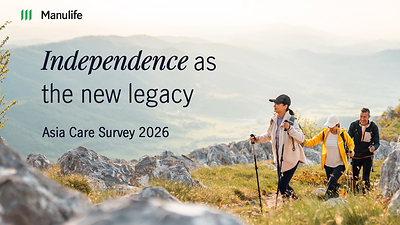
From living long to living long FreePeople across Asia prioritize health and financial self-sufficiency to achieve independence and avoid burdening loved ones
hong kong, 11 June 2026 /PRNewswire/ — As longevity continues to increase across Asia, people are rethinking what it really means to leave a legacy. Living longer doesn’t just mean adding years to life. Instead, Manulife Asia Care Survey 2026 Reflects a clear shift in mindset: people across Asia increasingly see independence, good health, financial self-reliance and freedom from dependency as the most meaningful legacies they can leave their families, helping to avoid becoming a burden on loved ones.
Manulife Asia Care Survey 2026
Freedom as the new inheritance – an inheritance free from burdens and dependence on care.
Based on responses from more than 9,000 adults across nine Asian markets, the survey sheds light on the less-discussed reality of longevity. On average, respondents estimate that nearbyfrom 1314 years oldLater stages of life may be spent in need of care or financial supportThere are increasing concerns about dependency and the pressure it can put on loved ones.
In this background, traditional ideas of heritage are being redefined. Over 80% of people across Asia say maintaining freedom and financial independence is more important than simply transferring moneyWhereas about 9 out of 10Says his goal in long life is to remain self-sufficient for as long as possible. Independence is being seen not only as a personal choice, but also as a way to protect family members from the emotional and financial burden of care.
People’s desire to see independence as a legacy is strongest in markets such as Indonesia (93%) and Vietnam (89%), and comparatively lower – but still with a clear majority – in Japan (63%), showing how strongly this idea resonates across the region.
“Across Asia, people are redefining what it means to leave something for the next generation,” he said Steve Finch, CEO of Manulife Asia. “Freedom has become the new and better legacy – because when people can take care of their health and finances, they maintain their dignity while freeing their families to live their lives.”
Good health is the foundation of freedom – but action is still lagging behind
For many people, the first line of defense against dependence on their family for care is good health. Two-thirds of people in all of Asia Now prioritize health and quality of life above all else, recognizing that staying healthy long-term is the most effective way to achieve meaningful independence in your later years.
However, awareness does not always match action. WhereasPreventive care and early detection are widely recognized as important — withmore than 80%agree that they help maintain independence – Practice still lags behind awareness. About half get regular comprehensive health checkups, And 1 in 10 have never had one. Less than 50% of people maintain a consistent exercise routine or balanced diet, highlighting the growing gap between intention and preparedness.
economic self–Dependence replaces dependence on children
With 89% of people across Asia prioritizing financial independence and self-reliance for as long as possible without reliance on the help of others, respondents are allocating a significant 68% of their total financial assets to support their independence, while only 32% is earmarked for inheritance. This is further reinforced by the fact that only 19% plan to rely on financial support from their children for their retirement and care needs. Together, these findings emphasize the importance of effectively deploying financial resources to generate the returns necessary to maintain long-term independence.
However, only 51% of respondents are using investments to cover their retirement and care needs – suggesting that many are not fully taking advantage of the potential of investment returns to support the independence they value so much. The gap is even more pronounced in some markets, including Japan (30%), China (40%), and Vietnam (43%), where significantly fewer individuals rely on investments to meet their independence needs.
“There is a clear gap between what people want and how they are acting. Many are prioritizing independence, yet are under-utilizing the investments that can help them achieve it. Too often, financial planning is seen as a choice between supporting one’s own independence and leaving a legacy – but that mindset can be limiting,” he said. Fabio Fontanha, CEO of Wealth & Asset Management, Asia, Manulife. When used effectively, investing can generate income, preserve capital and grow wealth over time. Individuals don’t have to choose between living independently and creating a legacy – they can plan for both.”
Encouragingly, signs of progress are visible as individuals are beginning to adapt their financial planning approach. Of those who have investment, insurance and savings plans, 40% are moving towards income-generating investments, while 38% are increasing diversification across asset classes – creating a deliberate focus on building flexible portfolios to support long-term independence.
Retirement at age 65 is losing relevance
As concerns about dependency grow, the traditional concept of retirement is changing. The survey shows that 74% of people across Asia plan to continue working past the age of 65Not just for income, but to maintain independence and financial flexibility. Throughout the area, flexible part–time work is the most preferred position–65 arrangementWhile many respondents in markets such as the Chinese Mainland (39%) and Japan (32%) prefer to continue working full-time – highlighting that people choose different forms of work as they adapt to longer lives. Overall, these changes reflect a broader rethinking of later-life work as an active way to stay engaged and independent.
The pressure of care makes independence a family issue
The desire for freedom also reflects today’s realities. nearby half the people in all of asiaCurrently provide care or financial support to family membersAnd the impact is especially pronounced among the sandwich generation. 6 out of 10 caregiversSay these responsibilities already impact their ability to secure long-term health and financial independence for themselvesReaffirming why planning ahead is seen as a responsibility for the entire family – not just one person.
Early and open family conversations help – yet many people still avoid them
Open communication plays a vital role in converting intentions into action. Nearly 70% of people across Asia believe that having early discussions with family members about aging, retirement, and caregiving expectations leads to better well-being later in life.. Yet, more than 40% haven’t had these conversationsOften because they don’t know how and where to start. People who have had these discussions – or who have worked with a financial planner – report significantly higher quality of life, underscoring the value of early planning.
The insights highlighted in this year’s Asia Care Survey are in line with the Manulife Longevity Institute, a global research, thought leadership, innovation, advocacy and community investment platform that will help people thrive at every age. Learn more about Manulife’s longevity research and insights: manulife.com/longevity.
About Manulife Asia Care Survey 2026
Manulife Asia Care Survey 2026 The survey was conducted via online questionnaire between February and March 2026 in nine markets: Chinese Mainland, Hong Kong, Taiwan, Japan, Singapore, Malaysia, Indonesia, Philippines and Vietnam. More than 9,000 adults aged 18 and older participated.
About Manulife
Manulife Financial Corporation is a leading international financial services provider, headquartered in Toronto, Canada. Driven by our ambition to be the number one choice for clients, we operate as Manulife in Canada and Asia, and primarily as John Hancock in the United States, providing financial advice, insurance and health solutions to individuals, groups and businesses. Through Manulife Wealth & Asset Management, we provide global investment solutions, financial advice and retirement planning services to individuals, institutions and retirement plan members around the world. At the end of 2025, we had more than 37,000 employees, more than 106,000 agents and thousands of distribution partners serving more than 37 million customers with operations in 25 markets globally. We trade on the Toronto, New York and Philippine Stock Exchanges as ‘MFC’ and on the Hong Kong Stock Exchange under the ticker symbol ‘945’. Not all offerings are available in all jurisdictions. For additional information please visit manulife.com.
About Manulife Longevity Institute
The Manulife Longevity Institute is a global research, thought leadership, innovation, advocacy and community investment platform that promotes action that can help people live longer, healthier and more financially secure lives. Building on a $350 million signature commitment, its focus is on helping people extend their healthier years, promoting greater financial flexibility for all. As a global insurer, retirement plan provider and asset manager, Manulife is uniquely positioned to help lead this change. The Institute’s work will support Manulife’s Impact Agenda strategy by investing in organizations that are growing the longevity economy, conducting research collaborations with leading academic institutions and think tanks, and producing thought leadership to advance awareness and action on issues affecting the aging population. The institute will be known as the John Hancock Longevity Institute in the United States. The Institute’s work will be guided by a steering committee of members from Manulife’s executive and global leadership teams and partnered with a strong ecosystem of longevity champion partners and experts in Canada, Asia and the US. Canada, Asia and America.
Smart Wealthhabits shares practical insights on personal finance, wealth building, and small business strategies to help readers make smarter financial decisions and achieve long-term financial success.