

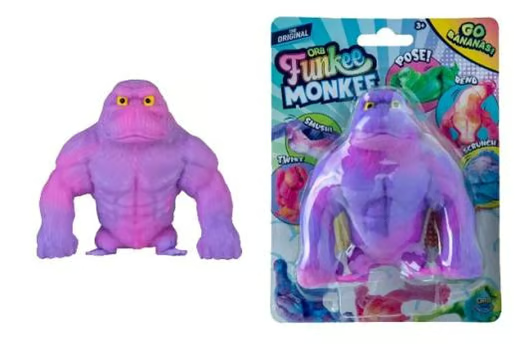
Thousands of children’s squishy toys have been recalled because they may contain the cancer-causing mineral asbestos.
The sand filling in the recalled Orb Funky Squeeze toys sold nationwide at popular retailers like Walmart may contain tremolite, a fibrous mineral known as asbestos, according to a May 21 notice from the Consumer Product Safety Commission. If asbestos is inhaled into the body, it can be harmful to health.
Approximately 121,340 “Monkey” toys are affected by the recall. No injuries have been reported.
Here’s what you need to know and what to do if you have a toy recalled.
Check Your Toys: Affected products sold at Walmart, Ollie
Two models of monkey-shaped Orb Funky toys are included in the recall. One is a large, golden figure labeled “Golden Monkey”, while the other is an assortment of smaller, multicolored “Funky Monkey” toys. Date codes can be found on the hand of the golden monkey or on the back of the smaller models.
- Product Name: Orb Funky “Monkey” Squeeze Toys
- Affected models: Model 17451 and Model 41929
- Date Code: 3102491A
- Sold at: Walmart, Ollie’s Bargain Outlet stores nationwide from February 2025 to April 2026
- Price Range: Between $5 and $40
What to do with a recalled product
CPSC advises consumers to take the recalled toys away from children, stop using them immediately, and contact the Orb factory for a refund.
According to the notice, if the toy is broken or has holes, or if sand has escaped from the toy, the Orb factory instructed consumers to wear a mask and gloves and use a wet cloth to pick up the leaked sand.
Consumers with affected squeeze toys will be asked to verify the toy’s code and lot number, place the toy in a heavy-duty plastic bag, seal the bag securely with tape, and submit a photo of the product in the bag at (email protected) to receive a refund.
“Consumers should dispose of the bags in accordance with local and/or state regulations,” the notice says.
Any items used to dispose of the recalled toys, including clothing, masks and gloves, should be placed in a heavy-duty plastic bag and then re-bagged and sealed with tape before disposing of them.
Affected consumers can reach The Orb Factory by phone at 800-741-0089, via email at (email protected) or online between 8am and 4pm ET, Monday through Friday.
What is asbestos?
Asbestos is a broad term for a group of naturally occurring fibrous minerals found in rock and soil. Its strong, heat, chemical and electricity resistant fibers can be spun into fine threads useful in a variety of products from clothing to construction insulation.
Asbestos was used extensively in commercial and industrial manufacturing, especially construction, in the United States until the late 1980s, when the Environmental Protection Agency banned all new uses of asbestos. Although its use has been phased out over the past few decades, you can still find the mineral in everything from paint on walls to coatings on water pipes in old buildings.
After it was discovered that asbestos had adverse health effects, including cancer, asbestos was deregulated and taken out of mainstream use in the US.
When asbestos is disturbed, small particles are released into the air. When inhaled, they can become trapped in the lungs and, over time, accumulate in the body. According to the EPA and National Cancer Institute, it can cause inflammation, scarring and lung disease that can make breathing difficult.
According to the EPA, asbestos is classified as a carcinogen, meaning it causes cancer in humans. It has been linked to mesothelioma (a relatively rare cancer of the thin membranes that line the chest, abdomen, and heart); Cancer of the lungs, larynx and ovaries; Noncancerous changes in the lungs; and asbestosis, a chronic, inflammatory condition of the lungs that can cause breathing problems, coughing and permanent damage. The National Cancer Institute says most cases of mesothelioma are thought to be the result of asbestos exposure.
Repeated, sustained exposure is generally considered necessary for severe disease to develop. The CPSC and EPA have found that limited contact with small amounts of the mineral, although not recommended, presents a low health risk.