

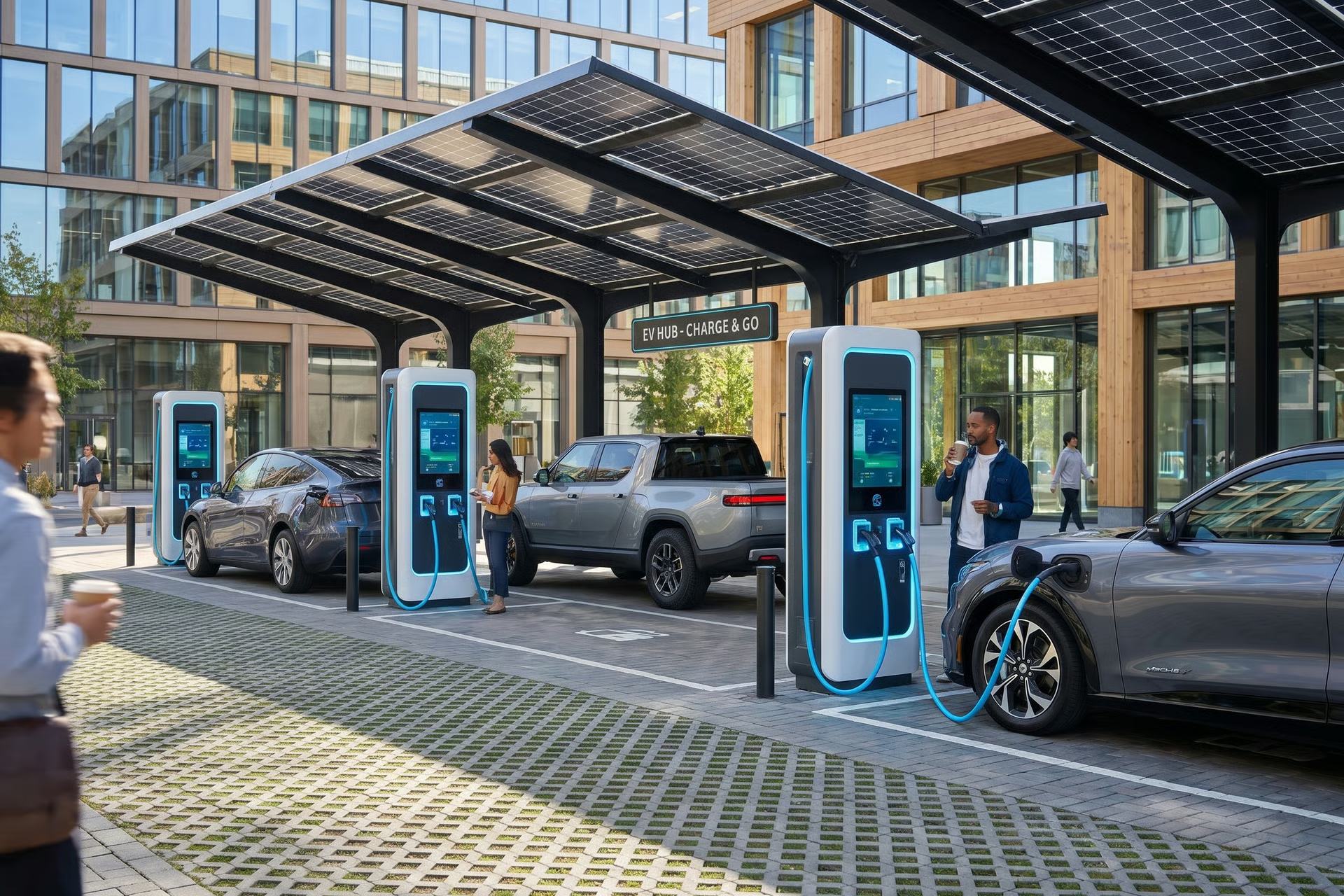
Congress is considering legislation that would eliminate a federal program that once provided $5 billion for electric vehicle chargers, and EV proponents say that would make things worse for drivers who are already concerned about range.
The charger funding program, known as the National Electric Vehicle Infrastructure Formula Program, was originally included in the 2021 Infrastructure Investments and Jobs Act signed by former President Joe Biden. It was left out of a new bipartisan draft of a five-year surface transportation funding bill being considered by Congress that could become law in October, meaning the program would expire after five years.
Biden-era EV charger money has been at the center of a legal battle since the start of President Donald Trump’s second administration in January 2025. The Trump administration initially attempted to eliminate the funding unilaterally, but a court ordered the U.S. Department of Transportation to proceed with funds that had previously been appropriated.
“EV charging infrastructure is an essential part of our nation’s transportation infrastructure,” Ben Prochazka, executive director of the Electrification Coalition, a Washington-based nonprofit that lobbies for EV-friendly policies, said in a statement.
Prochazka said NEVI and other federal charger funding programs “have supported the deployment of thousands of chargers across the country, helping to ensure that the millions of Americans who choose to drive electric now or in the future have reliable, accessible access to refueling infrastructure.”
What will ending charger money mean for EV drivers?
Car buyers have been telling pollsters for years that they have major concerns about the battery range of electric cars. This concern has come up so often that it has been dubbed “range anxiety”.
According to a survey released by the group EVs for All America in January 2025, 20% of 600 respondents said their top concern about plug-in models is the charger network being unreliable.
The same survey showed that 65% of respondents said they would prefer charging for a period of seven to eight hours at home to fully charge their battery, while only 29% said they would prefer a 30-minute charge at a public facility that would yield 80% battery life.
“Although significant progress has been made on the deployment of charging infrastructure in recent years – thanks in part to funding programs – lack of access to charging remains a top concern among many Americans interested in purchasing an EV,” Prochazka said.
Funding in the NEVI program was supposed to help fix this. The legislation includes $5 billion for states to boost U.S. charging infrastructure that is set to phase out in 2026. It also includes $2.5 billion in competitive grants for alternative fuel corridors and chargers in underserved areas.
At the time the funding was hailed as a game changer for creating a nationwide network of chargers on federal highways. The DOT said there are “more than 192,000 publicly available charging ports and approximately 1,000 new public chargers are being added each week.” According to the Alliance for Automotive Innovation, by the end of 2025, there were 53,662 unique charger locations with 236,893 fast-charging-capable ports.
Has the skepticism over charger money hit EV adoption since then?
Charger money has long been a target of Trump and congressional Republicans, along with a $7,500 tax credit for EV buyers that was eliminated last year.
After the tax credit expired in September 2025, US EV sales declined sharply.
Despite major headwinds from the disappearance of federal tax credits and tariffs on imported cars and parts, carmakers are projected to sell more than 1.2 million electric cars in 2025.
According to data released in January by Cox Automotive, carmakers projected to sell 1,275,714 electric cars in 2025 — about 8% of total U.S. auto sales — but that number was 2% less than the 1,301,441 EVs sold in 2024.
However, used EV sales are increasing, Cox said. Carmakers sold 82,629 new electric vehicles and 42,924 used EVs in March 2026.