

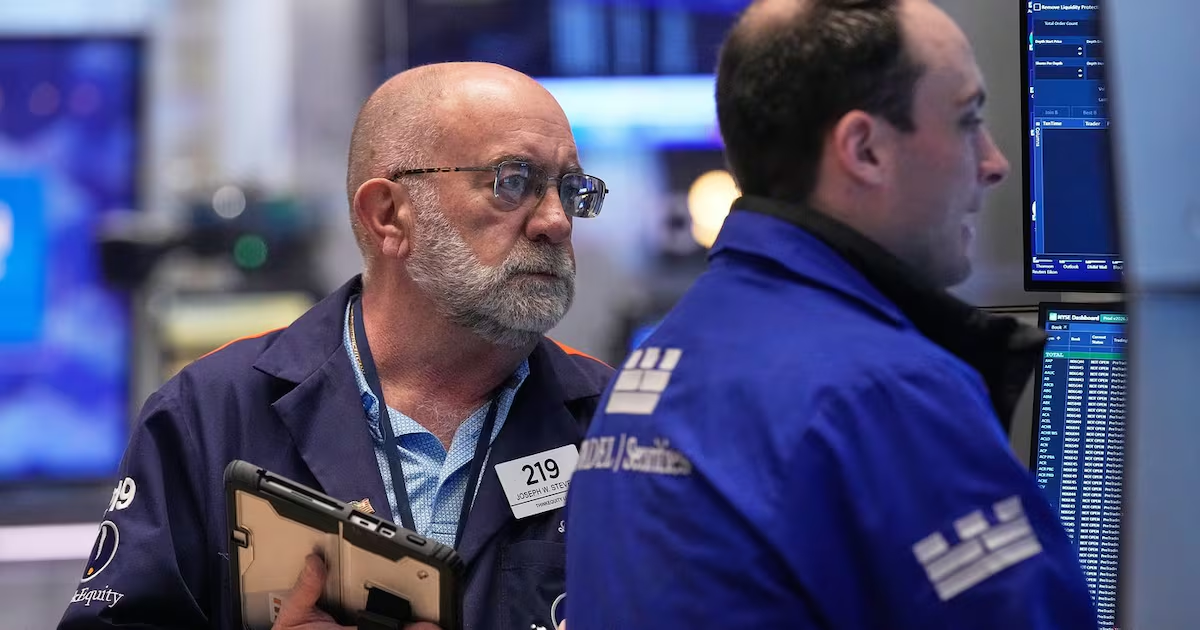
A stronger-than-expected US earnings season is bolstering confidence in the broader market as investors look beyond technology stocks for opportunities. AI-driven productivity gains, resilient consumer spending and improving market breadth are supporting corporate profits, even as geopolitical tensions and inflation risks remain in focus.
BNN Bloomberg spoke to Brian Szytel, co-chief investment officer of The Bahnsen Group, about the key themes emerging from earnings season, the outlook for technology stocks, dividend-growth investment strategies and why Accenture, Blackstone and McDonald’s stand out in the current market environment.
key takeaways
- Supported by strong consumer demand, AI-related capital spending and favorable capital markets, U.S. companies beat earnings expectations in the first quarter.
- Investors are increasingly looking for opportunities outside mega-cap technology as market leadership spreads into sectors with strong valuations and dividend yields.
- Rising energy prices linked to the Iran conflict could put pressure on consumer spending and contribute to inflation, potentially leading to a US Federal Reserve cap.
- Dividend-growth investors are favoring companies with strong free cash flow, sustainable business models and a history of returning capital to shareholders.
- AI implementation and infrastructure remain key investment themes, with companies across consulting, data centers and financing poised to benefit from continued spending.
Read the full transcript below:
Lindsay: Earnings season is winding down in the US and a number of topics are coming to the fore as a result of better-than-expected earnings. Let’s find out what those themes are and get some ideas for your portfolio. Joining us now is Brian Szitel, Co-Chief Investment Officer of The Bahnsen Group. It’s great to have you join us. Thank you very much.
Brian: It’s great to be back with you.
Lindsay: So we’re reaching the tail end of this earnings season. What would you say are the top narratives developing over the past few weeks?
Brian: Well, it was a great quarter more or less across the board. You have about 90 percent of the companies reporting, but 84 percent of them have beat, and year-over-year earnings growth is up 27 percent, so that’s strong. Across the board, you’ve got a combination of multiple factors. You have a strong consumer, you have a strong backdrop for the economy. You have also benefited greatly as real revenues have started flowing in from the surge in capital expenditure in the AI sector, and your productivity has increased. Then you have favorable capital markets.
The combination of all those things, in addition to record margins — call it 20 percent right now — made it a good quarter across the board.
Lindsay: However, many of the results we saw occurred before the conflict began in Iran. We have also seen inflation rising in the US. Do you think these two factors could impact some of these companies in the next quarter?
Brian: They certainly can, and these two things match. Iran conflict raises energy prices. Of course, this flows through the CPI, but it will also flow through the consumer’s ability to spend on goods and services. So it will be interesting to see how much of a role it actually plays in Q2.
Some of the positions we hold in our portfolio are expected to be on margin. “I think the starting point of how strong the economy was and how strong the consumer was gives a lot of safety margin there,” he said. But you are right – Q1 did not include anything to do with the increase in energy prices from Iran.
Lindsay: Yeah, it’ll be interesting to see how that factors in moving forward. We saw the market move ahead of technology at the beginning of the year, but now we are seeing a tech resurgence. You can disagree with me if you think this is not correct. What are your thoughts on what we’re seeing with technology during the first half of 2026?
Brian: It was unprecedented. Tech has delivered. There is something to be said about what the valuations of the sector are, how much you are paying for that delivery and how long these results can continue in a linear fashion, but there is no doubt that the results were phenomenal in Q1.
I suspect this will be an ongoing theme as investment continues, both in companies getting money to build AI and hyperscalers, but also in businesses benefiting from productivity gains. I am sure the story will continue.
Again, for us as dividend-growth investors, we are looking for businesses that can profit, but are also fairly priced and will distribute some of those profits back to shareholders in a growing dividend income stream. From a technical perspective, this limits the scope significantly.
Lindsay: So you have some stock picks, and now we’ll go through them, starting with Accenture. Tell us a little more about why you chose this company.
Brian: If you think about it, Accenture is a global IT consulting business. It’s a company that sells services to the Fortune 500. If you think about companies that are implementing some of these AI themes and systems, they will need Accenture to do that.
The literal reason the stock has halved is because there was concern that AI will more or less displace business models, and we don’t see that as a viable outcome. I think Accenture will benefit from applying its own AI to its business, increasing its operating leverage and benefiting its clients. Then on the demand side of the equation, I think things will work out quite well.
You’ve found a company that has raised its dividend for 20 years. Its yield is 3.7 percent. Again, it’s 50 percent off, so it’s a good value game. There are many things we like about Accenture.
Lindsay: Blackstone is another company that you might like. You say it is one of the lowest priced large caps in the market. Tell us more.
Brian: it is. Blackstone’s dividend yield at today’s entry point is 3.9 percent. This is about 40 percent below its peak in late 2024. Some of that story is really just the baby being thrown out with the bathwater, with the concern — more media concern than actual loan-default concern — in the private credit sector.
But you’ve got the world’s largest alternatives manager still growing assets by 12 percent in Q1. The markets weren’t up 12 percent in the first quarter, so that means that despite private debt concerns, they’re still bringing in a lot of new capital.
Behind this story you have a data center game with AI. You have a very diverse, very old business behind it. So we like Blackstone at this level as well. I think you get a lot of quality and a good dividend yield from that name.
Lindsay: And before we let you go, McDonald’s very quickly – why do you like it?
Brian: If you think about what I said about consumers being somewhat upset by rising gasoline prices – they’re up 40 percent – I think there’s, for lack of a better way to put it, a divide between the haves and the have-nots. People are still buying premium stuff, but at the lower end they are focusing on McValue menus.
Here you get a yield of 2.7 percent. This is about 18 percent less than the highest level. McDonald’s is a buy.
Lindsay: Okay, we’ll leave it there. Brian Szitel, Co-Chief Investment Officer, The Bahnsen Group truly appreciates your time. Thanks for joining us.
—
This BNN Bloomberg summary and transcript of the May 13, 2026 interview with Brian Szytel is published with the help of AI. The original research, interview questions and additional context were created by BNN Bloomberg journalists. An editor also reviewed this content before it was published to ensure its accuracy and compliance with BNN Bloomberg editorial policies and standards.