

To paraphrase the late jazzman Mose Allison, young Americans have nothing in the world these days.
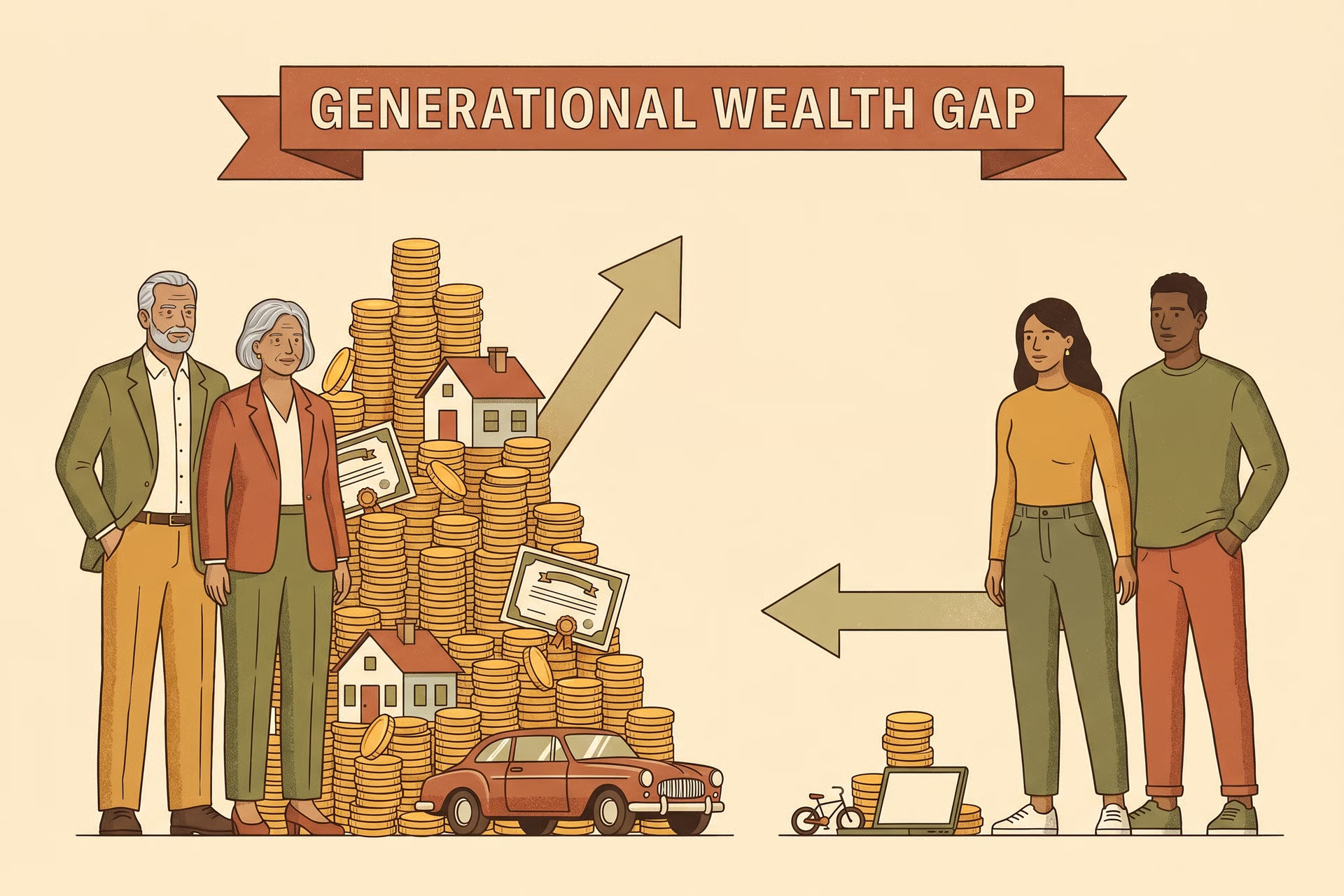
According to household data from the Federal Reserve, Americans age 45 and under control only 11% of the country’s wealth.
In other words, nine-tenths of America’s wealth belongs to America’s older half. People aged 45 and over constitute about 42% of the country’s population and about 54% of adults.
Boomers, the generation born between 1946 and 1964, hold 51% of American wealth: a mountain of real estate, stocks, pension benefits, private businesses and other assets, collectively worth $90 trillion at the end of 2025.
Generation
The shrinking group of Americans over the age of 80 own 12% of US wealth, valued at $21 trillion.
The remaining US wealth, valued at about $19 trillion, belongs to everyone else: Millennials, born between 1981 and 1996, and the oldest members of Generation Z, born in 1997 or later.
Older Americans are as wealthy as they have ever been
Older Americans are as wealthy as they’ve ever been, and they’re getting richer. According to Empower’s estimates, the average 50-something is worth $1.4 million. The average 60-something is worth $1.6 million.
In contrast, the average 20-something is worth $139,243, and the average 30-something is worth $325,952.
The pattern seems clear: age creates wealth.
Boomers, the wealthiest generation, control $31 trillion in stock and mutual fund shares, according to the Fed. He has real estate worth $19 trillion. Due to the rising stock market, rising home values, and the steady accumulation of home equity, the collective value of those assets has increased over time.
To some extent, the concentration of wealth among the old is due to the simple flow of time.
“Building wealth is like a snowball rolling down a hill,” said Richard Fry, a senior researcher at the Pew Research Center. “It takes time to become a big snowball.”
If you consistently save for retirement throughout your career, investing in stocks and bonds, the value of your account is likely to grow geometrically.
For Americans over age 65, the average Vanguard retirement account balance in 2024 was $299,442, the company reports. For savers ages 25 to 34, the average balance was just $42,640.
If you buy a home and take out a 30-year mortgage, your home equity will steadily increase over time, both through your payments and the increasing value of the property.
“These are things that are going to accumulate over the life cycle,” said John Sabelhaus, senior fellow in economic studies at the Urban-Brookings Tax Policy Center.
The economics of wealth creation are changing
But the economics of wealth are changing in ways that may make it harder for young Americans to build it.
The age of first-time home buyers is now 40, a record high, according to the National Association of Realtors. The average age of all home buyers is 59 years.
“If you live in an affluent part of the country, which is almost everywhere now, and even if you have substantial assets, even a very high income is not enough to buy a home,” said Dinon Hughes, a 25-year-old certified financial planner in Portsmouth, New Hampshire.
American workers are expected to build retirement savings over their careers, a model designed to concentrate wealth among the elderly. Previous generations were more reliant on workplace pensions.
Retirees are living longer, which means their heirs will have to wait longer to inherit money. Americans ages 56 to 65 are most likely to inherit, according to a 2021 analysis from the Wharton School of the University of Pennsylvania.
“I’ve got a bunch of clients whose parents are passing away, but most of them are in their 60s,” said Laurie Allen, 43, a certified financial planner in Hermosa Beach, California.
It is difficult to compare different generations over time. Still, Boomers clearly controlled more of America’s wealth in their (relative) youth than Millennials and Boomers.
According to Fry at Brookings, in 1991, the year the oldest boomers turned 45, America’s younger half held about 23% of total wealth.
(The tricky part: Boomers in 1991 made up a larger share of the population than Millennials do now.)
Will Millennials and Gen Z ever catch up?
The good news for Millennials and Generation Z is that there are many encouraging signs that they will accumulate a lot of wealth in the years to come.
“Millennials are going to inherit more from their parents than boomers,” said Wayne Winegarden, senior fellow in economics at the Pacific Research Institute. But they won’t see that money for another 20 or 30 years.
Several recent reports show that the Millennial generation is building wealth at a faster rate than older generations, and they now own more wealth than control older generations at the same age.
Gen Z and Millennials generally started saving for retirement earlier than Gen Xers or Boomers, and they are avid savers.
According to Fidelity’s report, the overall 401(k) savings rate for Gen Z workers is 11.3%, which is not far behind the savings rates for Millennials (13.5%) and Generation X (15.4%). Savings rates are important for young adults, as Gen Z is decades away from retirement.
“We all understand that we need to save something for our retirement, and everyone is taking advantage of the benefits they have,” said Hughes, a Gen Z financial planner.
Researchers say that between retirement savings, eventual home ownership and inheritance, Millennials and Zoomers will ultimately accumulate enormous wealth. But it will take time.
“They’re young. They haven’t had much time to accumulate yet,” said Fry of Pew. “This is the magic of compounding. And compounding is magic, but it takes decades to work its magic.”
USA TODAY, Reporting by Daniel De Visse.